2024 Oscars – All Best Picture Nominees Ranked

The Oscars. The defining declaration of a film’s quality, except not at all. The Academy Awards consistently frustrate me (especially after last year’s abominable slate of winners), yet for whatever reason I oddly adore the ceremony and the pretentious, insignificant chaos that is the awards race. So, given that we’re mere weeks away from the 2024 Oscars and I’m admittedly excited, it’s time to rank all 10 Best Picture nominees.

10. Maestro

Every year the Oscars have one distinctly abysmal Best Picture nominee that makes me go, “WHAT.” 2022 had “Don’t Look Up,” 2023 had “Triangle of Sadness,” and now 2024 has… Bradley Cooper begs for an Oscar for two hours. Yes, “Maestro” is visually breathtaking. Yes, Carey Mulligan is magnificent. But those elements cannot make up for “Maestro” being the most egregious Oscar bait I’ve seen in years, maybe ever. The film has zero emotional resonance due to its bland and underdeveloped screenplay. I feel like I knew more about Leonard Bernstein before I watched this film than after. You wouldn’t know Bernstein was an interesting person just by watching this dumpster fire. Nothing happens in the movie. Not a thing. “Maestro” actively challenges you to stay awake. It is so mind-numbingly dull and lacks any artistic merit beneath the surface level visuals. Watching this film is like being dead for two hours — it’s that brutally boring. I despised Cooper’s “look at me, I’m acting!” dreck to oblivion. There is no excuse for releasing a feature length Oscar reel. Not to be that guy, but I’m going to be that guy: this isn’t cinema. This isn’t a real movie. This isn’t acceptable. This is a soulless waste of time that is genuinely one of the worst films of the year.

9. Killers of the Flower Moon

2024 Oscars Killers of the Flower Moon

Lily Gladstone’s performance as Mollie Burkhart is mesmerizing. She captures strength and frailty, love and dread, hope and cynicism — all in the same performance, often at the same time. This is brilliant work and I’m elated that she’s earned so much praise for it. Likewise, Robert De Niro gave his best performance of the 21st century, maybe even beyond that, as the skin-crawling William King Hale. However, those performances can’t make up for Martin Scorsese’s self-indulgent misfire. I apologize in advance for what will be a lengthy rant, but I must get my arguments across.

I despise the peer pressure to automatically bow down to Scorsese and his work, even when it’s deeply flawed like “Killers of the Flower Moon.” Not only is this movie at least an hour and a half too long, but it is set for failure from the get-go by focusing on a thoroughly uninteresting, one-dimensional, idiotic, and irritating character in Ernest Burkhart, when the real focus should have been on Mollie/the Osage, or at least on the FBI like the book this was based on. But of course, Scorsese wanted to work with his buddies and have Leonardo DiCaprio play the lead, and for whatever reason DiCaprio was unwilling to play FBI agent Tom White, who he was originally supposed to play, and instead wanted to portray this evil plank of wood moron. The first two hours are just the same plot point repeated over and over again: Ernest meets up with a shady character, asks him to kill an Osage member, the guy is hesitant but agrees, and then we see him shoot someone. The film beats you over the head again and again. Defenders of the film say that the repetitiveness demonstrates how these murders became a cycle and almost a way of life, but I found that effort unsuccessful. Since the film is from Ernest’s perspective and the evils just follow the same predictable structure, it isn’t engaging or impactful, and thus I unfortunately didn’t feel the emotions Scorsese attempted (or claimed to have attempted) to elicit.

Let’s talk more about Marty. This is criminally self-indulgent and self-absorbed direction, giving himself four cameos (three offscreen voiceovers and that “look at me” appearance at the end). How does that demonstrate his empathy for the Osage, or prove he acknowledges and repents his exploiting tragedy for entertainment like he claims? If that was true, why not make a documentary instead? Why insert himself offscreen three times when he easily could have hired someone else? Why focus the story on Ernest rather than on the Osage? Why pay his pal Leo $40 million if this came from a genuine and well-meaning place rather than a self-serving one? I’m tired of the discourse that this is Scorsese’s latest masterpiece or that it’s his most important film. It could have been his most important film, but he approached it from the wrong angle, both in the screenplay (I’m pleasantly surprised and grateful that the Oscars didn’t nominate this script) and the self-aggrandizing nature of the bloated runtime, cameos, and “I want to work with my buddies” approach. I won’t apologize for finding this film to be a frustrating disappointment and an acidic blotch on Scorsese’s career. It is overlong, repetitive, and full of questionable at best filmmaking choices (such as the exposition dump ending and Brendan Fraser’s razzie-worthy performance — how did he win an Oscar?). Scorsese has given us some all-time classics, but “Killers of the Flower Moon” isn’t one of them. We have to hold him to the same standard as all other filmmakers and criticize his work when appropriate.

8. Barbie

Barbie 2024 Oscars

I’m mixed on this one. “Barbie” excels in its direction and performances, but dizzily falters in its messy screenplay that — let’s be honest — is just “The Lego Movie.” On a technical level, this film is truly an achievement. Barbieland is perfectly crafted with every minute detail given clear thought and attention. It is a world one can’t help but want to jump into and explore because Greta Gerwig flawlessly transports us and makes us feel like we know the landscape just as well as the dolls who inhabit it. Gerwig’s direction is inarguably some of the year’s best, not only with her brilliant technical precision but in how she handles the whimsical tone and performances. Everyone has raved about Ryan Gosling as Ken (and rightfully so), but I actually thought Margot Robbie’s performance was the standout, as she balanced the doll mannerisms with a deep vulnerability and innocence.

However, that screenplay needed some serious work. As soon as we travel to the real world, the narrative is a jumbled mess full of plot holes (How does the portal between the worlds work? Can anyone in the real world stumble into Barbieland as long as they have roller skates and sway into that exact location in Los Angeles?). Then there’s the unruly three act structure. Normally in films the second act is the longest, with the first introducing us to the characters and conflict, the second exploring the conflict, and the third concluding the film with a climax and resolution. With “Barbie,” there is a proper first act, but the second act is just the real world elements which only last for about 25 minutes, before we go back to Barbieland in the one-hour-long third act for a climax that drags and drags and drags. The film just would not end. Finally, let’s discuss the messaging, specifically the execution. I have no interest in getting into the culture war debate on whether “Barbie” is man-hating — everyone has their own interpretation and I honestly don’t care enough to comment on it. What I do care about is the quality of the satirical writing. Unfortunately, the execution of the messaging is so in-your-face, extreme, and repetitious, with a lazy ending in which the conflict is resolved by people ranting at others and explicitly stating the messages.

7. American Fiction

“American Fiction” easily has the smartest premise of the year. Unfortunately, it only partially lives up to its ambitions as a much-needed apolitical satire on race, because it only cares about being said satire for 40% of its runtime. The other 60% is a wildly inferior Hallmark Channel family melodrama distracted from the brilliant message on how insecure, implicitly racist white people decide what constitutes a “black story” for African Americans. Unfortunately, in between the satire we have to sit through our protagonist Monk mourning his deceased sister, putting his dementia-ridden mother in a nursing home, dealing with his drug-addicted brother, and fostering a romance with a neighbor. All of these miserably sappy interactions create an unruly ADHD screenplay that lacks focus. We go from a hilarious scene to a brain-stimulating conversation on race between two black authors to… Monk’s family housekeeper marrying a straight-out-of-a-sitcom local cop to his brother throwing a wacky house party. Why? Who cares?

There is a ton of potential in this story, much of which is executed to comedic perfection. Some of the best scenes out of any movie this year come from “American Fiction,” so it’s immensely frustrating whenever we cut away to the Hallmark sludge. Honestly, each time the film embraces the satire, it succeeds with flying colors. Every single joke in those sections lands, which is something almost no comedy accomplishes. “American Fiction” could have and should have been great, but it never reached that greatness because it couldn’t recognize its own potential.

6. Anatomy of a Fall

2024 Oscars Poor Things

To be clear, there is a chasm in quality between this film and the previous four. “Anatomy of a Fall” is actually solid, whereas those other movies were either atrocious (“Maestro”), decent but flawed (“American Fiction”), or somewhere in between (“Killers of the Flower Moon” and “Barbie”). Justine Triet’s Palme d’Or winning film about a woman put on trial for the suspicious death of her husband only lives up to its acclaim after the first hour. For a long time, the film moves at an incredibly slow pace, one which is far more meandering than methodical. However, once the trial begins, the film dramatically picks up speed and becomes absolutely engrossing for the next hour and a half. The case is so thoroughly detailed to the point where you forget this is a fictional story and feel like you’re watching real court proceedings, albeit with a filmmaking flourish. Sandra Hüller is phenomenal in the film, able to play sympathetic and despicable simultaneously. The beauty of “Anatomy of a Fall” is that the audience never finds out whether she actually murdered her husband or not, and that ambiguity is the key to distinguishing the film from all other courtroom dramas.

5. Poor Things

We have finally reached the tier of films that I consider well-deserving of a Best Picture nomination. “Poor Things” is a wonderfully strange movie, packed to the brim with creativity and optimistic energy to match its unforgettable lead character Bella Baxter. Emma Stone’s Bella is in many ways the perfect protagonist: she is effortlessly likable while being just as flawed and strange as the rest of us. The screenplay by Tony McNamara impeccably balances slapstick comedy with Hero’s Journey storytelling, making for a one-of-a-kind demented Frankenstein story full of heart, imaginative visuals, and lots and lots of sex (this film is going to be uncomfortable for a lot of viewers). Emma Stone brings so much charisma and vulnerability to the character. She perfectly captures Bella’s naivety at the beginning of her journey, her torment in the middle, and her secure adulthood at the end. As Bella matures in each scene, Stone makes gradual alterations to her performance following along with the character’s evolution. It really feels like we’re watching someone mature from an infant to an adult at an accelerated — but never rushed — pace. Overall “Poor Things” has some of the best character writing and character acting of the year, and I pray Emma Stone gets a well-deserved Oscar for her fearless and unprecedented work.

Unfortunately, “Poor Things” is held back by its 2 hour and 20 minute runtime. At about the 2 hour mark it reaches a natural satisfying conclusion and suddenly decides to backtrack into a new subplot before it can actually end. Bella’s arc was already completed and I suspect the seemingly tacked-on ending was only there to leave off the film with an unnecessarily larger climax. The film truly overstays its welcome to the point where the final 20 minutes are a slog to get through, and I wish it stuck the landing better.

4. The Zone of Interest

“The Zone of Interest” is a methodical and minimalist study of evil in its realest form: apathy. The film follows Rudolf Höss and his family as they live in a peaceful home with a gorgeous garden and a charming little pool, hosting delightful parties with friends and family… all while directly bordering the Auschwitz concentration camp. Höss, the commandant of the camp, wakes up, goes to work, returns home, reads his children bedtime stories, and sleeps by his wife. The family could not be more stereotypical, and the fact that they can function in such a simple manner while slavery and mass genocide are right beside them is the true horror. Mastermind writer/director Jonathan Glazer shoots the film exclusively from their peaceful perspective and never shows us the interior of Auschwitz. What he does present is just as, if not more, terrifying: the sounds. In almost every scene is a variety of screams, gunshots, and burnings we hear but never witness. The film’s intentional repugnance is propelled by Mica Levi’s wholly unique (but very sparingly used) score that can only be described as the sound of evil. Levi’s snub for Best Original Score is one of the year’s most egregious.

Glazer’s film is the most frightening and skin-crawling film I’ve seen in a very, very long time. He places the audience right beside the lowest scum of the earth, making us feel implicit in their atrocities and even challenging us to reflect on our own lives. “The Zone of Interest” is a brutal and effective representation of the Holocaust and pure human evil.

3. The Holdovers

2024 Oscars The Holdovers

We need more movies like this. That phrase has become unbearably overused, but in the case of Alexander Payne’s latest dramedy “The Holdovers,” it is actually applicable. The age of heartwarming character-based films has basically been dead for the past 15 or 20 years, and wasn’t even all that prominent post-1980s. “The Holdovers” is not only aware but proud of its uniqueness, as its visual and auditory style feel straight out of the 1970s with a delightful screenplay straight out of the 1980s. The gruff sound design and grainy images are utterly transportive. The characters are so rich and exciting to spend time with, and Payne’s ability to bring out the emotions really shines here, especially during the simultaneously inspiring and gut-punching ending when star Paul Giamatti puts his massive acting chops on full display. This is a delightful holiday film that I’m positive will stand the test of time to become a Christmas classic.

2. Oppenheimer

Oppenheimer 2024 Oscars

Like everyone else who experienced “Oppenheimer,” I was astounded. Astounded by Cillian Murphy’s career-defining performance. Astounded by Hoyte van Hoytema’s hauntingly beautiful cinematography. Astounded by the best direction of Nolan’s career. Astounded by its staying power. Oppenheimer’s greek tragedy as the American Prometheus demands to be told on the big screen and Nolan greatly surpassed my admittedly apprehensive expectations. Throughout the film it is abundantly clear how passionate Nolan feels about the subject matter, but most importantly he never forces a stance on the audience. He portrays Oppenheimer as he really was: a brilliant and sympathetic yet deeply flawed man who became his own worst enemy due to his indecisiveness. He is never portrayed as the hero nor the villain, and each viewer is left to create their own interpretation.

Cillian Murphy truly gave the performance of a lifetime here. The man is in almost every scene and in each one he’s able to make Oppenheimer even more compelling than the last. Through subtle performance and those iconic eyes, we experience so much yet somehow so little of Oppenheimer’s thoughts. The subdued performance complements Nolan’s ambiguous “up-to-the-audience” approach perfectly, and if Murphy doesn’t win Best Actor (and I fear he won’t), that will be yet another massive blemish on the Academy’s record. This is the kind of work that will be studied in decades to come.

1. Past Lives

2024 Oscars Past Lives

Celine Song’s quiet and universally relatable feature debut about relationships and the what-could-have-been’s of life left me self-reflecting more than any other film this year. The “Past Lives” screenplay is some of the most thematically rich writing put to screen over the last decade or more. With just three characters and impeccable dialogue, Song creates a beautiful yet tragic love story that’s more about lost opportunities and pondering whether one has made the right decisions than it is about plain romance. “Past Lives” is constructed on a foundation of extreme realism without a speck of forced romantic drama, in which each character is devastatingly palpable and sympathetic. After a while, you forget you’re viewing a film and feel like you’re just people-watching, much like the offscreen couple whose voices we hear at the beginning: “Who do you think they are to each other?”

No film this year was more emotional, devastating, relatable, or impactful than “Past Lives.” I cannot recommend this movie enough. This is one of those very rare films that every viewer can enjoy and take something away from. “Past Lives” exemplifies the best of storytelling and proves why cinema is so significant.


Click here to read my ranking of the 2023 Best Picture nominees!

“Mishima: A Life in Four Chapters” – Classic Film Reviews #32

Mishima: A Life in Four Chapters

“Mishima: A Life in Four Chapters” by writer-director Paul Schrader is undoubtedly the most unique biopic ever crafted. Released in 1985, the film tells the true story of the infamous and massively acclaimed Japanese author Yukio Mishima, a complicated man (to the say the least) who evolved from an innocent young boy into a radical political figure, delivering what he believed to be the ultimate sacrifice on November 25, 1970. Yet his story is not told in the conventional “this happened, then this happened, and finally this happened” manner. Instead, the film cuts between black-&-white sequences of Mishima (played masterfully by Ken Ogata) narrating brief excerpts of his life and play-like reenactments of three of his novels to demonstrate how he expressed the most intimate parts of himself through his work.

The reenactments of the novels The Temple of the Golden Pavilion (in Chapter 1: Beauty), Kyoko’s House (in Chapter 2: Art), and Runaway Horses (in Chapter 3: Action) reveal more information about Mishima’s belief system, internal struggles, and contradictions than the moments which follow Mishima in the real world. Over the movie’s first three chapters, the self-insert characters in each book reflect a core principle or struggle of Mishima’s, namely sexual inadequacy, bodily perfection, and fascism (this guy was dangerously out there, but the film never stops to glorify or denounce Mishima — a non-stance stance all biopics should take). During the black-&-white sequences of the real Mishima which interrupt the book reenactments, we see a more minimalist and cold point of view. Thus, for the majority of the film, we know more about Mishima when we don’t actually watch him, which is such a unique concept.

Mishima

The final chapter, Harmony of Pen and Sword, recounts Mishima’s final day with a singular timeline in color, but without the abstract theater style, thus combining the parallel storylines and balancing the realism of the black-&-white sequences with the emotion of the book sequences. Mishima is forced to face how the world actually perceives him and what his true place is more than ever before during this fourth chapter, leaving the audience pondering whether his final choice gave his life more or less meaning.

Beyond Schrader and Mishima’s exquisite pages, the film also thrives in its visuals and sound. John Bailey’s cinematography is truly one of a kind. His brilliant use of color, specifically contrasting deep blacks with colorful blues, reds, and golden yellows create a dreamlike landscape that captures imagination itself. Of course, his work is amplified by the stellar art direction and production design, which are almost certainly the best I’ve ever seen. The reenactments are staged on purposefully obvious sets with painted-on nature and limited space for the actors to move around in. You can even see the dents, cracks, and creases in the walls, yet the visuals and style are so powerful that it’s impossible not to buy into and appreciate them. There is a strange magic to the sets, possibly because they illustrate the confined space of the mind or simply because they elicit the feeling of a pop-up book.

Then there’s Phillip Glass’s music. Wow. This is one of the greatest scores in cinema history. Stunning, moving, exhilarating, devastating, and majestic all at the same time. I know I sound pretentious in saying that, but trust me, the score is that great. The film would not be as magical or transportive without that booming music elevating it throughout.

Mishima

Usually I avoid using the word “poetic” to describe movies, but I’ll make an exception for “Mishima: A Life in Four Chapters.” This film accomplishes something no other movie has done before or since, which is the combination of the literature and motion picture mediums into a whole new form of storytelling, one that I struggle to define in a single word.

A+

“Expend4bles” is Hilariously Abysmal – Review

Expend4bles

“Expend4bles” (pronounced “Expend-four-bles,” of course) is the fourth and unequivocally final film in the 13-year-old action franchise. The first 3 films were built on the idea of bringing together ‘80s and ‘90s action stars, led by the great Sylvester Stallone. That premise is catastrophically outdated, as the age of the movie star is over. So, the makers of this film were unconcerned with the original foundation of the franchise and thus gave Stallone a smaller role, instead emphasizing a wannabe Marvel action flick over the throwback gimmick. The film, released in September 2023, was made for $100 million and grossed a whopping $51 million. In the year of the flopbusters, “Expend4bles” was one of the most devastating. Objectively, this is a complete train wreck of embarrassing incompetence in front of and behind the camera… but I loved the atrocity.

“Expend4bles” fails at every level, generally due to its arguably unprecedented laziness. Let’s start with the acting, or lack there of. At their best, the actors are sleepwalking, and at their worst, they’re hysterical — namely Randy Couture and 50 Cent. Couture seems to actually be trying, but his background as a UFC fighter who decided to become an actor is glaringly apparent. He delivers an almost jolly performance, not in the sense that his character is happy-go-lucky, but more in the sense that Couture’s proud of himself for being able to utter words. Obviously, I want Couture to be in all films from now on.

But the true star here is 50 Cent. WOW. I am shaken from that powerhouse performance. In every single one of his scenes, it seems like he didn’t read the script and instead had an earpiece telling him what to say without any context. He exclaims banger one-liners like “That’s what I’m talkin’ about!” as if he’s attending a funeral.

The actors’ egos are even funnier than their performances — the cast evidently used this film to congratulate themselves for 90 minutes. Starting with the mind-numbing 50 Cent, there’s a scene in which his song “P.I.M.P.” unironically plays with his character in the frame. As soon as I heard it, I was gasping for air laughing so hard. Yet that’s not all. By far the best example of narcissism — and the most unintentionally hysterical scene in the movie — is courtesy of Jason Statham. In the middle of the movie, Statham’s character Christmas (that’s his actual name) is filmed on a live-stream while working security at a wealthy influencer’s party. Throughout the stream, we see the viewers typing the thirstiest comments in the chat; clearly, Statham demanded the writers insert said comments to inflate his ego. Here are just some of the cringeworthy bangers (word for word):

  • “He’s hottt!”
  • “I want his baby!”
  • “Bet he has a big 🍆”
  • “Sexy mofo ✋”
  • “I think I’m pregnant 🔥🔥🔥”
  • “GOD. DAMN. HE IS HOTTTT!!!”

Now let’s delve into the Shakespearean dialogue of “Expend4bles.” As previously mentioned, the writers clearly tried to rip off the MCU quips but with an R-rated twist… and once again failed disastrously. Mr. Cent unironically asks “snitches get stitches, right?,” characters talk extensively about getting urinated on, and Megan Fox sits on Statham’s face, proclaiming “this was always my favorite seat in the house.” Disgusting, idiotic, repulsive, unforgivable… stellar writing.

Expend4bles Jason Statham

The visuals are equally stellar. If the cast and crew didn’t shoot the entire film inside a warehouse, I’d be astounded, because all of the outdoor shots are green screened to oblivion. My personal favorite contains Oscar-worthy thespian 50 Cent atop a tank, appearing as if he woke up from a 48-year-long slumber, with the sky awkwardly shifting behind him. To make matters worse (or better, if you’re watching this for laughs like me), the entire second half takes place on the deck of a boat, so Statham and company run around in front of what looks like tissue paper. Why couldn’t they have shot on-location instead? They had $100 million, yet they couldn’t afford to do so? The only explanation is that 98% of the budget went toward the actors.

On top of the remarkable green screen, we have unbelievably cheap CG blood squibs that defy the laws of physics, explosions that seem drawn by an orange sharpie, and a CG aircraft carrier that’s “Birdemic” levels of bad. It is as if the producers snatched someone who’s never seen a computer before, shoved them in front of one, and told them to do their best in 45 minutes.

Expend4bles Sylvester Stallone

What a tragedy that I didn’t see “Expend4bles” when it was first released. If I knew it would be this hilariously bad I would’ve snuck into the world premiere instead of just watching and reviewing it several months later. That said, I still saw it, and while it’s certainly an abomination against everything good in this world, it’s also a world-class comedic experience. Please, go see it, and buy every 50 Cent album as soon as possible.

D-

Top 10 Best Movies of 2023

2023 has been a rollercoaster year for cinema, not only because of all the “flopbusters” but also because of the many disappointments. However, there were still plenty of gems this year, so it’s time to rank the 10 best movies of 2023 (without having seen “The Zone of Interest,” as it’s barely in release). Let’s start with some honorable mentions:

  • Are You There God? It’s Me, Margaret.
  • Asteroid City
  • Creed III
  • Poor Things (super close to making the top 10)
  • Teenage Mutant Ninja Turtles: Mutant Mayhem

10. May December

May December

Director Todd Haynes’ study of manipulation and abuse is one of the most powerful dramas of the year. The film follows an actress named Elizabeth Berry as she shadows Gracie Atherton-Yoo for a biopic about the latter. At 36 years old, Gracie had sex with 13-year-old Joe Yoo, gave birth to his child, and later married him once he became an adult. Needless to say, “May December” tackles serious subject matter, and it does so with flying colors due to the layered screenplay and top-tier cast (although it suffers from a horrendously inappropriate and melodramatic score). The script explores the subject matter through multiple perspectives and illustrates how manipulation became addictive to not only Gracie but also Elizabeth, who will stop at nothing to achieve the best performance possible.

All of this is heightened by the stellar performances, namely Natalie Portman as Elizabeth and Charles Melton as Joe. Portman plays Elizabeth with an almost seductive artificiality, as Elizabeth doesn’t have her own personality, but rather personas used to obtain what she wants out of different people. Her performance is a masterclass in subtlety. Charles Melton is the heart of the film as Joe, delivering a deeply tragic performance as someone who never fully experienced a proper childhood and is still emotionally abused as an adult. Melton defies his massive frame with a pathetic and quiet demeanor that encapsulates all we need to know about Joe’s mental state.

9. Guardians of the Galaxy Vol. 3

Guardians 3

Although 2023 saw the beginning of the end for superhero movies atop the disastrous sludge released by the MCU, James Gunn’s heartbreaking conclusion to his “Guardians of the Galaxy” trilogy broke Marvel’s losing streak. This is one of the most emotional movies of the year. Rocket’s origin is perfect tragedy storytelling. Although I knew the characters introduced in the Rocket flashbacks likely died before the present storyline, as I watched those loving creatures their deaths actually became surprising. My cynicism faded away and was replaced by empathy for Lylla, Teefs, and Floor. Beyond the Rocket elements, the present storyline is also incredibly well written, with all characters going on their own fully formed character arcs, most notably Drax and Starlord. Speaking of the latter, Chris Pratt’s performance as Starlord might be the best of his entire career.

“Guardians of the Galaxy Vol. 3” is a truly special superhero film, as it consistently emphasizes character and heart over action and universe-ending stakes. Plus, the movie contains one of the greatest villain lines in the history of cinema: “There is no God. That’s why I stepped in.”

8. The Iron Claw

Best Movies 2023 The Iron Claw

While I don’t think “The Iron Claw” is the masterpiece many have claimed, it’s still a great and deeply tragic film about familial bonds, competitiveness, and unfulfillment. The film details the triumphs and devastations of the real-life Von Erich wrestling family, and I implore those who haven’t seen the movie or heard of the “Curse of the Von Erichs” to avoid the tempting Wikipedia search. The dark turns are absolutely gut-wrenching and best experienced without knowing about them going in. “The Iron Claw” is a deeply intimate look at these real-life figures, increasing in quality as the tone darkens, leading up to arguably the best movie ending of the year with the most heartbreaking monologue of the year, delivered by an Oscar nomination-worthy Zac Efron.

7. Mission: Impossible – Dead Reckoning Part One

Best Movies 2023 MI7

Never doubt Tom Cruise. Once again, he has delivered an exhilarating film built on gloriously practical action. All of the action sequences are unforgettable, especially the sweat-inducing train car escape. Beyond the stellar action, this M:I installment is easily the most emotional and weighty. You feel the stakes in the drama, specifically because of the bold and absolutely correct choice of killing off one of the franchise’s staple characters. Additionally, the introduction of Hayley Atwell’s snarky thief Grace brought a welcome and surprisingly powerful character arc to this previously thrills-over-emotion franchise. Now, is Dead Reckoning better than Fallout? No, but arguably no action film reaches Fallout‘s heights. It’s incredible how this franchise has consistently maintained such a high level of quality, and I have full faith in Cruise and company to deliver once again with the eighth film.

6. The Killer

Best Movies 2023 The Killer

David Fincher’s “The Killer” follows a precise, sardonic, and rigorous assassin — essentially, Fincher if he was a mercenary instead of a filmmaker. Fincher does psychological thrillers better than any director, and he proves that once again with his latest film. Michael Fassbender is excellent as the unnamed titular character, somehow both gentle and unsettling at all times. He has very little spoken dialogue, and instead we hear his inner-monologues throughout the film in which he comments on his strategy, rules, and beliefs. This is an incredibly sick-minded character with no moral code, yet I could never take my eyes off him. While some might find “The Killer” monotonous because it’s simply two hours following the routine of an assassin after a job gone wrong, I thought it was endlessly engrossing.

5. BlackBerry

Best Movies 2023 BlackBerry

With the most riveting and anxiety-inducing screenplay of the year, writer-director Matt Johnson delivered a phenomenal satire on big tech in his movie about the rise and calamitous fall of the world’s first smartphone. “BlackBerry” certainly takes inspiration from previous tech biopics like “The Social Network” and “Steve Jobs,” but due to its accelerating pace and comedic edge, it stands out. The film shines brightest in its third act reminiscent of the chaotic finale of “GoodFellas,” when the characters pay for their impulsive mistakes in an explosive everything-goes-to-hell conclusion. Of course, no discussion of “BlackBerry” is complete without mentioning Glenn Howerton’s work as vicious co-CEO Jim Balsillie, which is my favorite performance of the year. Howerton is hilarious with his animalistic rage and irritated one-liners (“Thirst is a sign of weakness.”), but also quite pitiful. Ultimately, this is a character who makes all of his decisions based on revenge and a constant need to prove himself. Yes, Howerton’s performance is incredibly loud, but more importantly there’s an insecurity beneath his glaring eyes during the quiet moments which produces a simultaneously sympathetic and despicable character.

“BlackBerry” is an exhilarating film that deserves way more attention than it’s getting, so if you haven’t seen it, please do.

4. Air

Air

Is “Air” the dad movie of the year? Yes, but so what? Despite being about the creation of a basketball shoe, which sounds like a mind-numbingly boring premise, “Air” is supremely entertaining and uplifting due to an incredible screenplay, wonderful characters, snappy dialogue, passionate direction by Ben Affleck, and lively performances across the board. “Air” has plenty of soul, far more than 95% of movies released nowadays, and in effect it’s impossible not to fall in love with. I don’t always need my movies to be heartbreaking or thought-provoking or boundary-pushing — sometimes I need a fun, well-executed pick-me-up that I can watch over and over again. That’s exactly what “Air” is.

3. The Holdovers

Best Movies 2023 The Holdovers

“The Holdovers” is undoubtedly the most heartwarming movie of 2023. As usual for director Alexander Payne, this film is entirely character-based, similar to classic 1970s/80s movies. In fact, “The Holdovers” is filmed and recorded to feel straight out of the 1970s (which is also when the movie takes place) on a technical level. Paul Giamatti gives a career-best performance as pretentious curmudgeon Paul Hunham, a teacher left to watch over a handful of students (the holdovers) at a New England boarding school during winter break. Over the course of the film, Hunham bonds with the snarky trouble-making student Angus Tully (played by Dominic Sessa in his film debut), as well as school head chef Mary Lamb, a mother mourning the death of her son in the Vietnam War. All three leads are written and played to perfection. The script is witty and emotional, built on incredibly detailed characters who I could watch for ten more movies. While Giamatti and Sessa share the bulk of the screentime and humor, the standout is Da’Vine Joy Randolph as Mary, who balances a warm maternal energy with a somber core. It’s utterly impossible not to fall in love with these characters, and I can see “The Holdovers” becoming a Christmas classic.

2. Oppenheimer

Best Movies 2023 Oppenheimer

“Oppenheimer” is the culmination of Christopher Nolan’s entire career. The film features Nolan’s usual techniques like the non-linear storytelling and bombastic music, yet unlike most of Nolan’s work, which pulls off some techniques and fails to pull off others, “Oppenheimer” nails all of them. In fact, it fixes my issues with Nolan’s previous films, namely the lackluster dialogue and overbearing score. This is easily Nolan’s best screenplay, coupled with his most gorgeous and disturbing direction (particularly during the haunting gymnasium scene).

Nolan crafted an immensely compelling, flawed, and layered portrait of J. Robert Oppenheimer, fearless enough to emphasize the gray areas in Oppenheimer’s beliefs. Nolan doesn’t shove any messaging down the audience’s throat, and instead leaves most questions up to interpretation. All of this film’s brilliance is propelled by an astounding Cillian Murphy, who gives the year’s finest performance as Oppenheimer. No actor has eyes like those, and he utilizes them perfectly. Oppenheimer was nuanced in the script, and even more nuanced in the performance. Murphy plays the character with the proper stoicism and ambiguity, never falling into the flashiness trap. Overall, “Oppenheimer” was a stunning accomplishment that deserved its monumental success, and it has to be the defining film of 2023 at this point.

1. Past Lives

Best Movies 2023 Past Livess

I’m astonished that this is Celine Song’s feature film debut, because “Past Lives” is a revelation. The movie follows a Korean-Canadian immigrant named Nora who was wrested apart from her childhood love Hae Sung back in Korea. Now living in New York City with her Jewish-American husband Arthur, she reunites with Hae Sung in-person after 24 years of separation.

Realism is the key to “Past Lives.” Each of the three central characters are entirely grounded in reality, never behaving childish or melodramatic, amplified in their believability by the flawless dialogue. They just feel like real people talking, and that type of dialogue is the hardest to accomplish. “Past Lives” is never a love triangle, and not even much of a romance either. It’s really just a simple three-character drama about lost opportunities, and a reflection on if we’re meant to be who and where we are. Would Nora have married Hae Sung if she stayed in Korea, or would they have broken up anyway, only for Nora to marry Arthur? The film asks burdensome questions about life choices we can all relate to, and it has kept me reflecting on both the characters and myself ever since I first saw it. “Past Lives” is wholly unique, and the most poignant and thematically rich film of the year.

“Maestro” Review – Bradley Cooper’s Soulless & Dull Oscar-Bait

Maestro Carey Mulligan Bradley Cooper

“Maestro” was directed by Bradley Cooper and co-written by him along with “Spotlight” screenwriter Josh Singer. Cooper stars as famed composer and conductor Leonard Bernstein in a biopic focusing on the icon’s relationship with his wife Felicia Montealegre. While they were a legitimately happy and loving pair, Bernstein had poorly concealed affairs with men throughout the marriage that strained their relationship.

Like everyone else who saw Cooper’s previous directorial effort “A Star is Born,” I loved it. Thus, I was hoping after his five-year hiatus he would return with another smash hit, but because 2023 is apparently the year of cinematic disappointments, all he delivered was a self-indulgent, Oscar-begging, soulless slog of a film.

Before I rant, let’s get the positives out of the way. Firstly, “Maestro” is a visual marvel. Matthew Libatique’s cinematography is absolutely stunning and, most impressively, versatile. “Maestro” spans multiple decades of Bernstein’s life, with the first third of the film focusing on his earlier years as a conductor in the 1950s. For this portion, Libatique modeled the camerawork after grand 1950s musicals, with sweeping camera movements coated in beautiful and transportive black-&-white. Then, for the rest of the film which focuses on Bernstein’s life in the 1960s-1980s, the film shifts to color, and although it doesn’t utilize 60s/70s/80s aesthetics, it takes on a dreamlike quality that reflects Bernstein’s idyllic mind.

Maestro Carey Mulligan Bradley Cooper

“Maestro” also excels in its performances, namely Carey Mulligan as Felicia. She brings a subtle charisma and warmth to the character, and the audience can’t help but fall in love with her, just like Bernstein did. Mulligan also takes on lengthy monologues and takes with ease, culminating in a devastating revelation for Felicia that allows Mulligan to unleash all her acting chops without getting too showy. It’s a truly brilliant performance that’s well-deserving of an Oscar nomination, possibly even a win.

Mulligan and technical accomplishments aside, “Maestro” falls flat on its face, largely due to the abhorrent screenplay devoid of emotion or any fiber of a soul. This film fails to elicit even the most minuscule of emotions or life out of the audience until the aforementioned tragedy which befalls Felicia, but the only reason why that plot point lands is Mulligan’s performance, certainly not the script. Cooper and Singer speedrun through the decades, thus prohibiting any meaningful depth or strong character development. Oddly, at the same time the film feels brutally slow despite it rushing through time, simply because nothing really happens. We never actually witness Bernstein’s rise or learn for ourselves why his work is so magical — we just hear people say it is. That’s a textbook failure in following the “show don’t tell” rule. Cooper and Singer have zero interest in exploring Bernstein’s professional life, and since his personal life is oddly thin, there’s nothing to grasp onto.

Maestro Bradley Cooper

To put it bluntly, “Maestro” is so damn boring. It is a total lullaby of a film that actively challenges the audience to stay awake. Seriously, Cooper almost seems aware of the audience falling asleep, as many dialogue scenes will have long pauses to account for the viewers having to jolt awake between lines. I feel that I’ve accomplished a monumental achievement in maintaining consciousness throughout this bland, dull, and lifeless bedtime story. I have not seen a film so difficult to stay awake during in years. I almost never get tired during films, but this was a different beast. I may have developed whiplash from all the head-jerking.

I find it borderline repulsive how Oscar-baiting this film is. I barely even consider it a film, as it’s more of a demo-reel for Cooper to show off his new voice and conducting skills after 4 years of preparation. I don’t care how much time and effort Cooper spent to immerse himself into the role. Yes, he’s quite good, but he’s not Cillian Murphy good, let alone Carey Mulligan good. I could picture plenty of other actors doing just as well as Cooper. As a filmmaker he has a responsibility to make a film, not a compilation of pretty clips boasting his acting just to beg the Academy to “Pick me! Pick me!” This is textbook Oscar-bait with a black hole for a heart.

I’m giving “Maestro” a harsh but fair grade:

C-

The Killer, Anatomy of a Fall, May December – Quick Reviews

The Killer | A-

The Killer

“The Killer” marks perfectionist filmmaker David Fincher’s return to the psychological thriller. It stars Michael Fassbender as the unnamed title character, a meticulous assassin who loves a good self-indulgent internal monologue. After a hit goes wrong, his girlfriend is brutally attacked and nearly murdered as punishment for his mistake. Now the Killer must hunt down those guilty for the attack, using modern technology and his crafty intellect. I won’t lie: I am the target audience for this film. David Fincher making an assassin movie in which you follow the routine of a ruthless killer? I’m there.

I’m elated to say that “The Killer” did not disappoint. This was a relentlessly compelling, immaculately detailed procedural flick that puts you right in the disturbing mind of a psychopath. Throughout the film we listen to his internal diatribes about how he keeps empathy out of his life and “sticks to the plan,” which directly contradicts his improvised actions in the pursuit of vengeance. Thus, he’s a hypocrite and an unreliable narrator. I found this dynamic to be incredibly fascinating, and when combined with his 1) great intellect and 2) utter disregard for human life/compassion (outside of his girlfriend), Fincher has crafted one of the most mesmerizing characters of the year. I could watch his daily routine for hours.

Michael Fassbender gives a tour-de-force performance as the title character. His voice is so gentle and almost soothing, which serves as a stark and ironic contrast to the character’s actions. There’s a ferocity beneath his stare and (although this is most likely do to Fincher’s notoriously high number of takes) a sense that he has done all of this so many times before to the point of, as the Killer himself says, “boredom.”

The sound design here is also incredible. Take the Killer listening to music, for instance. The closer we are to his earbuds the louder the music gets, and the further away the quieter it gets, adding that special hint of Fincher realism. Fincher’s frequent collaborators Trent Reznor and Atticus Ross did the score here, and it’s just as unconventional as I hoped it would be. The music actually sounds like the noises of a murder we don’t see. Sometimes there’s what sounds like the gripping of leather gloves around someone’s throat, other times what sounds like distorted screams or breathing. It’s an incredibly disturbing soundtrack that’s certainly not pleasant on the ears but perfectly matches the vibe and energy of the film.

My main complaint with “The Killer” is its ending, which was so incredibly rushed that it felt as if the producer called time and ordered Fincher to cease shooting. The film reached a conclusion that would be interesting if it were more thoroughly explored, but instead we speed through it and I left the movie saying, “wait, that’s it?”


Anatomy of a Fall | B

Anatomy of a Fall

Justine Triet’s “Anatomy of a Fall” won the prestigious Palme d’Or at the 2023 Cannes Film Festival (essentially its “Best Picture”), an award previously won by films such as “Taxi Driver,” “Pulp Fiction,” “Parasite,” and… last year’s embarrassing “Triangle of Sadness.” After the husband of author Sandra Voyter (played by Sandra Hüller) fatally falls from their home’s balcony with his head bludgeoned by an unknown object, foul play is suspected. The film follows Sandra in the court case to prove her innocence, and secrets are revealed.

The ambiguity is this film’s greatest strength. Triet never definitively tells the audience whether Sandra is guilty or not. We never see the crime and know only as much as the jury. Ultimately that fearless ambiguity makes “Anatomy of a Fall” stand out from other courtroom dramas and allows for fun conversations to be had between audience members after viewing. Nonetheless the film still shines in those court scenes, which have Sorkin-esque snappy dialogue and compelling revelations. The performances are solid across the bard, although I don’t think Hüller is the Oscar-worthy phenomenon many are calling her.

Unfortunately, the film is held back by numerous flaws. Firstly, it is two-and-a-half hours long and it feels like it. The first act is a dull, generic, soulless slog that should have been trimmed to the bone. Once the trial (and ambiguous storytelling) actually starts, the film really gets going, but the pacing never fully recovers. I also found the camerawork distracting. At times the camera is completely still, reminiscent of Todd Field’s brilliantly subdued direction in last year’s “Tár.” However, at other moments Triet will do snap zooms and documentary style photography similar to “Succession.” The styles clash and distract from the tension. Additionally, some shots are legitimately out of focus and/or most of the screen gets blocked by character’s backs. Shocking for such a high-profile awards film.

“Anatomy of a Fall” is merely decent. It is far from a masterpiece and has serious issues in its structure and cinematography. In totality, it works well enough, but without Triet’s brilliant decision to rely on ambiguity the film would be utterly generic and unremarkable.


May December | A-

May December

Todd Haynes’ “May December” follows actress Elizabeth Berry (played by Natalie Portman) as she studies Gracie Athertoon-Yoo (Julianne Moore) for an independent film based on Gracie’s life. Gracie is an ex-felon who had sexual intercourse with 13-year-old Joe Yoo a couple decades back and successively gave birth to their child. After her release, she married adult Joe (played by Charles Melton) and had even more children with him. Gracie became a true crime phenomenon, and throughout the film we watch as Elizabeth observes how Gracie essentially robbed Joe of his childhood and made him into a young, naive boy trapped in a now-36-year-old’s body. The film tackles heavy themes of abuse, manipulation, sexuality, and the immorality of media and the entertainment industry — so it makes perfect sense that the Golden Globes nominated this film for “Best Musical or Comedy.”

Despite “May December” being nothing but people talking in rooms and occasionally backyards, it is endlessly engaging. Samy Burch’s screenplay is incredibly complex yet utterly simplistic. The dialogue feels so real and while her characters are rich on paper, Burch still allows for the performances to expand upon the material and craft wonderfully detailed roles.

Julianne Moore is deeply unsettling and power-hungry as Gracie, especially during one scene when she delivers the most vicious cry I’ve ever seen. Her jaw fires outward with each sob, and her wails are oddly aggressive and predatory. Charles Melton has earned praise as the breakout performance of the film, and it’s obvious why. Despite his massive figure and towering height, he contorts his body to appear invisible and weak, illustrating Joe’s utter lack of control over his own life. So much is delivered through his eyes and body language.

However, I strongly believe that Natalie Portman is the true revelation here. Portman never lets the audience learn who Elizabeth really is. She changes her personality, voice, and attitude depending on who she’s interacting with. While conversing with Gracie and her family, she puts on a soft-spoken, gentle voice to come off as the compassionate and down-to-earth actress. While conversing with her fiancé over the phone, she seems utterly annoyed yet still puts on a facade to hide her infidelities. While conversing with her director, she acts flirtatiously, seemingly out of the desire to obtain more control over the movie. Portman plays Elizabeth with a thirst for manipulation. She constantly alters her persona to extract what she desires from others. People seem like pawns to her. In her own way, Elizabeth is just as unsettling and controlling as Gracie, which is probably why she wants to play her.

Unfortunately, the movie is held back by its aggressively inappropriate score. The music is bombastic and overdramatic, much more suitable for a soap opera or a Victorian-era historical epic than this kind of story. On so many occasions, scenes are interrupted and diminished by the NUH-NUHHHHH, NUH-NUHHHHH. In isolation, the music is actually quite beautiful, but in context of this grounded film it is brutally distracting and adds an almost laughable element of melodrama that undercuts most of the best scenes.

“American Fiction” Review – Great Premise, Middling Execution

American Fiction

“American Fiction” is a social satire by first-time filmmaker Cord Jefferson. It stars Jeffrey Wright as Thelonious “Monk” Ellison, a brilliant but struggling African American author frustrated with the popularity of novels based on black stereotypes which almost exclusively serve white people who want to seem more racially conscious and, in oversimplified and overused terms, “woke.” As a joke one night, he writes a book parodying this under an alias, and suddenly the book is taken seriously and becomes a massive hit, much to Monk’s chagrin.

After seeing the trailer for this film, it became my most anticipated movie for the rest of the year. Finally, a Hollywood film that criticizes the leaders of the entertainment industry’s attempt to hide their own racial ignorance/insecurities by “promoting” what they perceive to be “minority stories,” which do not actually represent all of said minority group. This trend has been apparent for years and years, so it’s about time a high-profile film tackles it, especially in comedic form. Unfortunately, “American Fiction” doesn’t fully live up to its ambitions.

This film has a constant internal struggle between the much-needed message and the borderline-melodramatic family dynamics. One half of the film is the satire you actually want to see, whereas the other half is a jumbled, uninteresting exploration of Monk’s family. Whenever “American Fiction” focuses on the comedy, it really, really shines. This film has the funniest scenes of the year, and the gradual elevation of the absurdity is glorious. “American Fiction” is one of those incredibly rare instances where every single joke lands. My theater was roaring with laughter throughout, in large part due to Jeffrey Wright’s career-best performance. He plays the cynical aging man flawlessly; every word out of his mouth seems both inspired and exhausted. It is a truly magnificent performance that is well-deserving of an Oscar nomination.

Yet the theme isn’t only portrayed through comedy, but also through quieter moments. The best scene in the movie is between Monk and Sintara Golden (played by Issa Rae), another African American author who wrote the kind of book Monk despises. There is a wonderful, lengthy exchange of philosophies as they banter, during which the film portrays both sides of the argument thoroughly and objectively.

But then we have to cut from those scenes to Monk talking to his newfound girlfriend, or Monk’s homosexual brother dealing with their parents’ homophobia, or Monk having to put his mother in a nursing home. I’m sorry, but I just don’t care… at least about two of those relationships. The brother dynamic works well within the message and themes of the film, but the girlfriend and mother subplots are insufferably dull and unnecessary. This is a two-hour film and I could really feel it. Jefferson should have cut all of the family elements (except for the brother) out of the script and expanded upon the chaos surrounding Monk’s book. As is, the family drama detracts from the momentum of the actually compelling parts of the story.

“American Fiction” is unintentionally engineered for the Fandango Movieclips YouTube channel since it would be so easy to clip 10 laugh-out-loud satirical moments and leave out the boring family drama. This is Cord Jefferson’s first feature film screenplay and I’m sorry to say that it is blatantly apparent. He desperately needed a script doctor to focus the story. At its current state, “American Fiction” is a collection of moments, of two different films stitched together. One film is the modern-day “Dr. Strangelove” (that’s how phenomenal the satire is) and the other is a slightly elevated Hallmark Channel movie.

B

“The Holdovers” Review – We Need More Movies Like This

The Holdovers

“The Holdovers” is the latest film from director Alexander Payne and re-teams him with Paul Giamatti 19 years after their hit movie “Sideways.” The film takes place at Barton Academy, a New England preparatory school, in the winter of 1970. When Christmas break hits, most students return home, and the very few who don’t (the Holdovers) are left at the school under the watch of one unlucky instructor. This year, it is the pretentious and deeply frustrated history teacher Paul Hunham (Giamatti) who receives the duty. When Angus Tully (Dominic Sessa), Hunham’s sarcastic and rebellious student, is left behind for the break, the antagonistic pair learn just how similar they are… while launching vicious insults at each other.

I knew “The Holdovers” would be special when its opening credits sequence began with the line, “An Alexander Payne Movie.” Not “picture,” not even “film.” A movie. I know this sounds entirely inconsequential, but Payne’s use of the term “movie” is representative of how unpretentious and warm his filmography is. Payne makes movies for the audience, not just for himself. His films are delightfully character-based and packed full of emotion, wit, and humor. He makes the kind of movies we don’t get anymore, the kind that rejuvenated the film industry in the ’70s and ’80s. That’s why he is one of our finest filmmakers and why “The Holdovers” is one of the best movies of the year.

Payne brilliantly decided to give the film the appearance of a 1970s movie. The frame is consistently grainy, with occasional bursts of black or white specks that add to the life and realism of the film. The sound quality even reflects a ’70s film. In the hands of a lesser filmmaker, these techniques would feel flashy, unnecessary, and distracting. Under Payne’s smooth guidance, the grainy film and rough sound is utterly charming and transportive. “The Holdovers” really feels like a ’70s movie, and it’s all the better for it.

Paul Giamatti The Holdovers

The performances are the heart of the movie. Paul Giamatti is impeccable at playing condescending curmudgeons and this is no exception. He balances that fine line of being frustrating but never annoying. He is immensely likable despite the character’s plethora of flaws. The humorous core to his performance is his face, specifically his eyes and cheeks. Hunham is written to have a lazy eye that becomes a motif in the film, adding to the aesthetic insecurities of the character. I have never seen an actor utilize their cheek muscles better than Giamatti does here. He is able to vibrate most of his face to amplify the comedy, most notably during one scene in the middle of the movie at a doctor’s office.

This is Dominic Sessa’s first film and it’s impossible to tell just by watching his performance. Sessa is incredible in this movie, able to fire hilarious and vicious banter so naturally. He completely holds his own against Giamatti and their chemistry is immensely palpable.

I haven’t mentioned the third lead of the film yet: Mary, the head chef of Barton’s cafeteria, played by Da’Vine Joy Randolph. Her character is a deeply tragic one. She’s a mourning mother who just lost her son in the Vietnam War, but despite her anguish, she remains a strong-willed and kind figure. Randolph gives an incredible performance, playing the role with the proper subtlety of a woman storing her grief and with the warmth of a loving mother. She is the heart of the film.

The Holdovers Alexander Payne

The story, while one that we have seen a million times, remains gripping because of how well the characters, their arcs, and their interactions are written. It’s impossible not to root for them and fall in love with their belly-laugh-inducing banter. Watching Hunham and Angus bond is heartwarming but never cheesy or overwritten. This is a (mostly) incredible screenplay by David Hemingson, one that deserves an Oscar nomination.

I qualify that statement with “mostly” because the first act is noticeably inferior to the second and third acts. The first act is still decent, but it ultimately feels drawn out and trim-worthy. It wastes time by having multiple holdovers because all of them leave except for Angus. The other holdovers don’t really affect much of the story, and therefore feel inconsequential. I understand and agree with the filmmakers’ choice to place Angus alone with Hunham, but it could have been written better. The script should have made Angus the only holdover from the get-go or, preferably, make the other holdovers more important to the story. That said, I eventually stopped caring about the relative insignificance of the other holdovers because of how quickly I became invested in the relationship between Angus, Hunham, and Mary. I’m sure most viewers will feel the same.

“The Holdovers” truly is the movie we need right now. It has a rich, intelligent heart that’s absent from most movies today. We could all use an uplifting film, and Alexander Payne has brought us a great one.

A-

“Killers of the Flower Moon” Review – It’s Too Long, Marty

Killers of the Flower Moon Martin Scorsese

“Killers of the Flower Moon” is the latest film from acclaimed director Martin Scorsese. The movie is based on a true story about the abuses against the Osage tribe by white businessmen led by William King Hale (Robert De Niro). After the Osage strike it rich by discovering oil in their land, they’re manipulated by Hale, who moonlights as their ally so that whites can take their oil money by marrying and secretly murdering them. Leonardo DiCaprio plays Ernest Burkhart, Hale’s dim nephew who returns from World War I. Hale sees an opportunity within young Ernest and marries him to an intelligent Osage woman named Mollie (Lily Gladstone). However, Ernest unexpectedly falls in love with Mollie, and as the film goes on he becomes torn between loyalty to his uncle and wife.

When we see “A Martin Scorsese Picture” on a poster, it’s natural to expect nothing short of excellence. This is the mastermind behind “Goodfellas” and “Taxi Driver.” However, we must resist the urge to blindly love everything he does because of his track record, or any great filmmaker’s track record for that matter. In the case of Killers, which has been hailed as a “masterpiece,” I can’t help but feel it’s not being evaluated objectively. If this was directed by an unknown, it would receive far more mixed reception. The truth of the matter is that “Killers of the Flower Moon” is good, not great.

At three-and-a-half hours, “Killers of the Flower Moon” is… tough. I like to say that if a film is going to be longer than “The Godfather” (3 hours), you better earn it. The Lord of the Rings films do this. “The Godfather Part II” does this. “Schindler’s List” does this. Killers doesn’t. It’s not 206 minutes out of necessity, but out of an auteur’s indulgence. When he first wrote the film with Eric Roth, the script was a detective thriller from the FBI’s perspective, which is how the book of the same name was structured. This would’ve made for a faster, tighter film, but because Scorsese and DiCaprio felt Ernest was the “heart” of the story instead of Tom White (the main FBI agent played by the great Jesse Plemons), Roth and Scorsese tore the film “inside out.” In effect, there’s no intrigue or suspense moving the story along. Also, Ernest simply isn’t interesting. He’s too dimwitted to have the complexity of emotions required for a morally conflicted character. I couldn’t care less about him because he didn’t have the intelligence to reflect upon his flaws, and therefore there wasn’t any interesting character development.

After a while, I just stopped caring about all the characters, especially Ernest. This is generally due to the runtime. Mollie was an interesting character in theory, but the film often forgot about her throughout the second half due to its bloated subplots elsewhere. There were far too many scenes of Ernest meeting up with a new character, asking him to complete a task, and then we watch him complete a task we’ve seen a million times before. The first 2 hours are just that formula repeated to death, except with breaks for De Niro and Gladstone to inject life into the film with their acting chops (we’ll get to them later, as they’re the best parts of the film).

Leonardo DiCaprio Lily Gladstone Killers of the Flower Moon

Even the last 90 minutes, which are superior to the first 2 hours, could have been trimmed. Without spoiling anything, the last act has DiCaprio’s character make a decision that resolves the conflict, take back that decision, and make it all over again. Those are 20 minutes we don’t need. It’s not as if the film is strictly dedicated to historical accuracy — De Niro is 30 years older than the real Hale was at that time. Then the movie concludes with the most insulting ending Scorsese has ever crafted. Again, without spoilers, he ends the film with a massive exposition dump detailing what would take about 20-30 minutes more to tell, and which are also far more compelling than the first half of the movie. The exposition concludes with an embarrassingly self-aggrandizing Scorsese cameo in which he essentially looks right at the camera to proclaim, “hey look everybody, it’s me!” The message of the film is too important for that kind of ego, and his appearance detracts from said importance. The most aggravating part of this ending, however, is the fact that it essentially says, “We had three-and-a-half hours and $200 million to tell our story but we still couldn’t finish the whole thing, so here’s Scorsese to verbally rush through the ending at you.”

And yes, to those who’ve seen the film, I’m well aware that the point of the final scene was to illustrate how Americans didn’t take the atrocities committed against the Osage seriously. That’s a powerful and necessary message, but instead of cramming it into an exposition dump at the last second, they should’ve made an epilogue to complete the characters’ stories and, more importantly, properly explore that theme. Scorsese should have cut an hour out of the film to 1) make a smoother runtime and 2) give room for a different, extended ending. That way, we’re not insulted by his inability to make a reasonably long movie and we can also absorb the message properly.

Runtime aside, what works about this film? Despite my crotchety ranting, I was never bored during “Killers of the Flower Moon.” Yes, I was disconnected, but I never felt sleepy, and that’s due to the visuals, performances, and, as always with Scorsese’s films, Thelma Schoonmaker’s magic editing. She always knows what shot to place where to make the scene more interesting, and it’s hard to pinpoint her exact style; she’s just damn good at her job. The cinematography by Rodrigo Prieto is also masterful. The landscapes are nothing short of breathtaking and his lighting brings a truly haunting atmosphere that puts you in the trapped position of the Osage people.

No element better makes you feel the dread and oppression of the Osage better than Lily Gladstone’s performance. Her work is far from flashy, instead expressing Mollie’s emotions through eyes and slight mannerisms. It’s a subdued performance that immediately makes the audience connect to Mollie because of how real she feels. Therefore, when tragedies start befalling her and her family, it’s all the more devastating, especially in one scene in which Gladstone releases this raw, heart-breaking scream that Mollie had been holding in throughout the movie. I’d say Mollie, independently of Ernest, is the true heart of the film.

Robert De Niro Killers of the Flower Moon

De Niro was just as excellent. I legitimately believe this is his best role since “Raging Bull.” He instills the fear of God in you, playing Hale with a charming outer shell juxtaposed by a spine-chilling evil beneath his eyes. This is a truly transformative performance, the likes of which he hasn’t done since his early days working with Scorsese. I never saw De Niro, only this destructive soul willing to kill anyone in his path without batting an eye. As long as he’s in a position of power, you feel like no one else is safe, and his subtly vicious performance provides the tension which the script failed to build.

I’m shocked that I’m actually saying this, but the weakest element of this Martin Scorsese film is Martin Scorsese. His visuals and direction of actors are stellar as always, but his gift for story momentum is entirely absent. “Killers of the Flower Moon” is devoid of restraint or consideration for the audience, and due to its self-indulgence, it wasn’t able to fully realize its ambitions, although it had the right intentions. I do think the film accomplishes its most important task, which was to put the audience among the Osage people so we could experience their torment. Therefore, it is a decent film overall, but one that is too long and self-indulgent for me to fully recommend.

B-

Secret Invasion, TMNT: Mutant Mayhem, & More | Quick Catch-ups

Secret Invasion | D+

Secret Invasion Nick Fury Samuel L. Jackson

This isn’t the abomination against humanity which tons of critics and viewers have claimed, but it’s still quite bad. “Secret Invasion” is an utterly insignificant, unremarkable, and forgettable television series made only to add more content to Disney+. It takes one of the most iconic and compelling Marvel comics storylines (which could’ve made for an entire saga with multiple phases, by the way) and morphs it into a boring footnote of a story.

It also continues the trend of godforsaken and hellish MCU writing. The dialogue is so horrendous that it’ll make viewers ashamed of themselves just for listening to it. The pacing is all over the place, sometimes rushed and sometimes lagging behind. Worst of all, it takes characters we loved from previous MCU projects and obliterates them, particularly Nick Fury. Remember the badass, mysterious, hyper-intelligent super-spy from “The Avengers” and “Captain America: The Winter Soldier?” Remember how cool it was seeing him to go toe-to-toe with godlike beings? Well he’s long gone now. What this show brings us is a sad old man with the IQ of an 8-year-old who is revealed to have never been all that competent or important. Apparently, he used shape-shifting Skrulls to move his career forward all along, never having actually accomplished anything remarkable on his own. Why does Marvel want to tear down its own characters? I don’t get it.

Anyway, there are some redeeming qualities here. Olivia Coleman is fantastic in her role as the hyper-intimidating yet elegant Sonya Falsworth, who’s really what Nick Fury should’ve been. I also appreciate how this show doesn’t have forced humor and tries to be an adult-oriented spy thriller. It also has a memorable score (that’s unfortunately accompanied by an AI-generated opening title sequence). Ultimately, “Secret Invasion” is actually one of the better MCU Disney+ series, which just goes to show how wretched Marvel has become.

Teenage Mutant Ninja Turtles: Mutant Mayhem | A-

Teenage Mutant Ninja Turtles Mutant Mayhem

Wow, what a pleasant surprise. Mutant Mayhem is an extraordinary coming-of-age film reminiscent of the brilliant teen dramadies by John Hughes, only with humanoid turtles rather than people. It has an excellent wit to it, with snappy dialogue that keeps the film lively and the characters grounded. The turtles all interrupt and talk over each other, making that dialogue feel organic and spontaneous. They feel like actual adolescents, and this film benefits immensely by focusing on the Teenage element of “Teenage Mutant Ninja Turtles” more than anything else. Donnie’s voice still hasn’t dropped, Mikey hasn’t hit his growth spurt yet, Raph is full of teen angst, and Leo is distracted by his crush on a girl. The animation is also really unique and perfectly fits the chaotic and youthful nature of the turtles. My only real issue with the film is that the final battle was a little forced and had too many characters and events happening simultaneously. The movie comes to a natural thematic conclusion and then continues for another ten minutes just to get some action sequences in for the trailer. Overall though, this was a wonderful experience that has made me a TMNT fan.

Bottoms | B+

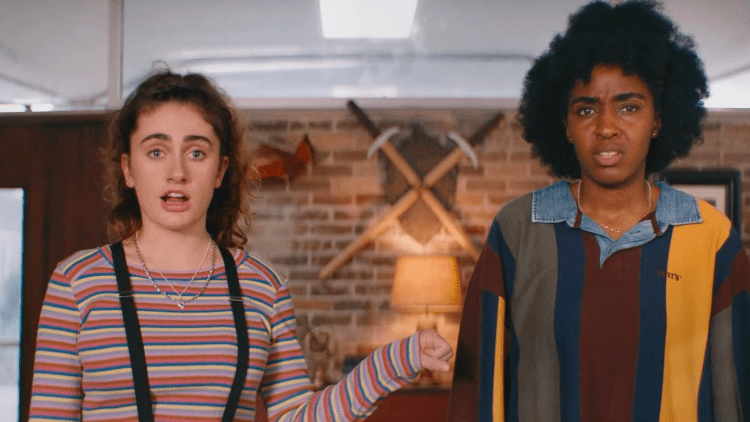
Bottoms Rachel Sennott Ayo Edebiri

Like Mutant Mayhem, “Bottoms” is another pleasant surprise. It follows two lesbian high schoolers who decide to create a school fight club to become popular. The film is incredibly volatile and crude, and that approach worked for the most part. There’s some hilarious jokes that really go for it; nowadays most comedies are prohibited from taking risks, and “Bottoms” isn’t afraid to get offensive and in your face. I laughed out loud multiple times in the theater, which almost never happens to me. Co-leads Rachel Sennott and Ayo Edebiri (who are close friends in real life) have radiant chemistry and despite their characters’ deep flaws (especially Sennott’s), you can’t help but adore them and root for them. The film moves at a brisk pace that never lets up, and despite its small budget it oddly feels larger in scale than it actually is.

Now, the film has two glaring issues: one is what I call “‘Superbad’ Syndrome” — like so many high school comedies since that film’s release, “Bottoms” shares too many similarities. Sennott essentially plays Jonah Hill’s character and Edebiri essentially plays Michael Cera’s character, and they even have a McLovin-esque sidekick who Sennott (like Jonah Hill) berates constantly. Both plots revolve around “nerds” trying to get popular and catch the attention of their crushes. Now, “Bottoms” isn’t a “Superbad” rip-off (that movie’s called “Booksmart”), but the 2007 film’s influence was distracting. The second issue is this movie’s struggle with realism. At times it’s somewhat grounded in reality and at other times (especially the gory ending) it’s about as realistic as “Moonfall.” There was some major tonal whiplash going on. Yet despite its flaws, “Bottoms” put a huge smile on my face and was one of the funniest comedies of the past few years.