All Stanley Kubrick Movies Ranked

Stanley Kubrick is one of the greatest filmmakers of all time. With so many classics under his belt, it’s difficult and inevitably controversial to rank them — but I’m doing it anyway.

13. Fear and Desire

Stanley Kubrick’s debut feature film is certainly his worst. There’s a plethora of laughable dubbing and awkward performances. It’s incredibly pretentious and self-indulgent (something Kubrick himself had even admitted). Much of the dialogue is poorly written, with characters essentially saying the themes instead of the story presenting its message through their struggles. This is most apparent at the beginning when the narrator (who only speaks once and never returns) lectures the audience about how wonderful the film is because the war in the background “is not a war that has been fought, or one that will be, but any war,” as if to say that “Fear and Desire” is some allegorical masterwork. It also doesn’t help that the costumes all look like WWII uniforms; there’s no hiding any of that.

With all that being said, I still wouldn’t call this a bad movie by any means. It’s well shot, moves at a decent pace, and is extremely competent for a debut film made on a shoestring budget by a 24-year-old director. The film also has a ton of charm to it, as well as a clear abundance of effort put in behind the camera. Kubrick showed immense visual talent right out of the gate. “Fear and Desire” isn’t very good, but it’s nowhere near as embarrassing as its reputation makes it out to be.

12. Killer’s Kiss

“Killer’s Kiss” is easily Stanley Kubrick’s most forgettable film, largely because it’s his most generic. A down on his luck boxer falls in love with a beautiful woman living across the street and must then save her from some gangsters she got mixed up with. Each character is one-dimensional, which is likely why the actors seem bored throughout the film. There’s very little soul here, save for some gorgeous cinematography here and there. “Killer’s Kiss” is slightly better than “Fear and Desire,” but you’ll forget about this movie’s existence five minutes after watching it.

11. Spartacus

Kubrick Spartacus

“Spartacus” is a debilitating 3 hours and 17 minutes long, and I felt every second of it. There’s something about this era of 1950s-60s 3+ hour historical epics that’s just so boring and soulless. It was like those decades’ version of the Marvel Cinematic Universe: factory filmmaking.

On a positive note, the entire film is breathtaking from start to finish. The set design, costumes, and (of course) Kubrick’s cinematography were all immaculate. The film is a treat to look at. While it’s on record that Kubrick directed this film to get more recognition in Hollywood rather than out of any artistic drive, it’s clear that he was still trying to do his best with what he was given. I also think that the first hour of this film is pretty enjoyable. It’s more focused on Spartacus before he led the slave revolution, allowing for a smaller scale (and therefore less bloated) narrative with more action and character development with less talking in tents, gardens, or bathhouses.

However, once Spartacus suddenly becomes this heroic figure and starts a war against the Romans, the eyelids start getting heavy. The emphasis shifts to a chemistry-lacking romance and some Roman politicians plotting against each other. The characters relentlessly talk about the war and how important it is and why the Romans are evil and how come the wind blows, but rarely ever engage in war. There’s no scene in which Spartacus actually plans battle strategies yet we’re supposed to believe he’s some terrific leader because people tell us he is.

The main issue with the film’s narrative is how inconsistent the Spartacus character is written. In the first act, he’s a quiet and brooding Man With No Name figure with almost no human connection. But all of a sudden he punches a guard, starting and subsequently leading a revolution as a holy figure. Why didn’t the slaves try to escape before? Don’t know. Why would they follow this cold loner of all people? Don’t know. How did Spartacus gain leadership skills? Don’t know. How did Spartacus and the other slaves understand how to ride a horse? Don’t know. How did Spartacus build an army capable of fighting the most advanced military in the world? Don’t know. How did Spartacus become such a friendly, inspirational, and loving individual all of a sudden? Don’t know.

“Spartacus” is frustrating because it had every potential to be fantastic. It had Kubrick at the helm, a great star in Kirk Douglas, an enormous budget, gorgeous production design, and a potentially interesting story. But the screenplay is just so by-the-numbers that no matter how well constructed or performed the film was, it was impossible for it to succeed. With the exception of 1959’s “Ben-Hur” (which is phenomenal by the way), “Spartacus” and other backdrop epics simply don’t hold up under much scrutiny.

10. The Killing

There’s a massive gap in quality between “Spartacus” and “The Killing.” From here on, I’d give all the films on this list a positive review. In this noir heist film, Kubrick crafted an intriguing and exciting story with a fun cast of characters. Sterling Hayden is great in the lead role as Johnny Clay (essentially the Danny Ocean of the film), an intelligent yet overconfident leader. The film moves at a fast pace and has a highly satisfying climax with a darkly comedic and Kubrickian ending.

Now, there are some issues here. Kubrick chose to tell the story in a nonlinear structure to thoroughly recount each piece of the heist, and while it sometimes works, it can also distract from tense sequences. This is made a lot worse by the use of an incredibly unnecessary narrator who goes into way too much detail about each event. Not only does he confuse the audience by giving the time of day every few minutes, but many of his lines are just lazily written, almost to an embarrassing degree. One banger he delivers is, “At 7:00 that morning, Johnny Clay began what might be the last day of his life.” Wow, thanks for letting us know. How else could we figure out that armed robbery is risky? It’s a classic example of telling rather than showing, something that screenwriters should always avoid.

9. Full Metal Jacket

Kubrick

“Full Metal Jacket” is so strange to me. I certainly fall into the camp of people who believe that the first 45 minutes are far more compelling than the rest of the movie. Watching Gunnery Sgt. Hartman, played to perfection by R. Lee Ermey, absolutely destroy the soul of Pvt. Pyle is simultaneously hilarious and heartbreaking. It shows how the dehumanization of war doesn’t only start on the battlefield, taking the audience through this devastating downward spiral. It’s a story about compassion and the chaos that can come about without it. Personally, I think it’s the best, most engaging, and most profound filmmaking Stanley Kubrick has ever done. Period. If the first act was just stretched out into a ninety minute movie, this would skyrocket to the top three in my Kubrick ranking.

Once the boot camp segment ends, “Full Metal Jacket” is still good (this is a Stanley Kubrick film after all), but it’s sort of forgettable. Basically it’s just Pvt. Joker accompanying a platoon as they try to survive and defeat a sniper for an hour. I enjoyed myself while watching it, but it’s definitely not top tier storytelling.

I wish I loved “Full Metal Jacket” a lot more, but because of the disjointed structure and jarring gap in quality between the two central stories, it doesn’t reach its lofty ambitions.

8. Lolita

Kubrick

“Lolita” is a two-and-a-half-hour movie about a pedophile, so going into this I was skeptical to say the least. But after watching it, I was amazed by what Kubrick created. It’s an extremely tasteful film, thankfully never showing Humbert and Lolita’s…um…relations. “Lolita” is actually a satire on the selfishness, pretentiousness, and hypocrisy of human nature, using humor to bring its point across. There’s so many hilariously awkward moments between Humbert and Lolita’s overstimulated mother, as well as between Humbert and his nemesis Clare Quilty, played to perfection by Peter Sellers (fun fact: Sellers based Quilty’s voice on Stanley Kubrick’s New York accent).

Beyond its dry humor, “Lolita” has plenty of emotional substance. Humbert is utterly despicable in how controlling he is of this young girl, even to the point where he becomes her stepfather just to get closer to her. Ultimately, “Lolita” is a cautionary tale of desire which effectively balances comedy and drama.

7. 2001: A Space Odyssey

Kubrick 2001

I know, I know. How could I not put “2001: A Space Odyssey” at the top spot? In all seriousness, I do actually enjoy 2001 quite a bit, but I can’t ignore its pacing issues simply because of how acclaimed it is.

2001 struggles with making its first act as compelling as its second and third. The film has a terrific opening with the Dawn of Man and the introduction of the Black Monolith. Yet once it transitions to Dr. Scientist Man and his mission to the Clavius lunar outpost and the long, drawn-out, self-indulgent sequences of ships slowly entering bigger ships, it loses me. I understand Kubrick’s intention was to hypnotize the audience and immerse them into the astonishing atmosphere of space, but the audience can’t get lost in the story when they start counting the seconds that go by for each shot. The first act has zero momentum or urgency that drives the plot along, and to make matters worse, Dr. Scientist Man is an awful protagonist. He lacks any character traits or complexity and is played by a charisma-vacuum of an actor. William Sylvester (the vacuum) was miscast in the role. He feels like an impersonator of a classy 1940s movie star, like a knockoff version of Humphrey Bogart or John Wayne or Henry Fonda, but without the acting chops or screen presence. So when there’s no forward-moving momentum, interesting characters, or plot development, visuals simply aren’t enough to keep me interested, no matter how gorgeous they are.

However, once the story transitions to Dave (Keir Dullea) and Frank (Gary Lockwood), it almost feels like a different movie. Suddenly the pace, visuals, and atmosphere all come together and Kubrick succeeds in his ambitions. The new leads are charismatic and give subdued, thoughtful, and deeply human performances. The slow-moving visuals also have more of a purpose, as they’re used to build tension and intrigue rather than simply be there.

2001 wouldn’t be as great as it is without HAL 9000, one of the best villains in cinema history. The red eye, haunting lines (“I’m sorry, Dave. I’m afraid I can’t do that.”), and eerie voice-over work by Douglas Rain are rightfully iconic. The way Rain over-pronounces every word, savoring each line of dialogue is spine-chilling. Even when he isn’t speaking he’s terrifying, namely the scene where he disconnects the life support of the crewmen in suspended animation. Yet despite all his evil, HAL’s motives are actually understandable. HAL is essentially programmed to advance the human race, so when he senses the Monolith and decides to jeopardize the mission in favor of a new one, he believes he’s being utilitarian, bringing about a new species of humans. He’s the hero of his own story, despite ultimately being a monster.

The film then crescendos in its magnificent finale with the gorgeous stargate sequence and Dave’s transformation into the new species created by the Monolith. It’s sequences such as these that prove why Kubrick is one of the greatest directors of all time.

While I don’t quite love the film, I greatly appreciate it and enjoy it more and more upon each rewatch. In time, I can definitely see this moving up higher on my Kubrick ranking. Even now I recognize that it’s a masterpiece, albeit a flawed one.

6. A Clockwork Orange

Likely Kubrick’s most disturbing work, “A Clockwork Orange” is a visceral experience. The ultra-violence and the ol’ Ludwig Van aren’t for everybody, but I love the film. Kubrick forces the audience into the sadistic mind of Alex, a despicable creature and one of the most horrifying villains in movie history. While he’s certainly a monster, Malcom McDowell’s complex performance brings something so tragic to the character. You certainly don’t feel bad for him, but you do find yourself disgusted by this dystopian future that’s very much the cause of his nature.

The world-building of “A Clockwork Orange” is truly exceptional, bringing a unique take on a futuristic society with perpetually relevant messaging about corruption in society, where public figures and politicians are more concerned about their image than protecting the citizens of their country. It’s a deeply cynical, exaggerated, and pessimistic view of humanity, but an important one.

5. Eyes Wide Shut

Kubrick Tom Cruise

Similar to “Lolita,” I went into “Eyes Wide Shut” with a lot of skepticism. I heard it was somewhat disjointed and obviously knew about its extreme subject matter. Luckily, I was immensely surprised at just how magnificent it was.

“Eyes Wide Shut” is Kubrick’s detective film, following Bill (Tom Cruise) on a journey that becomes more and more nightmarish as he discovers how deep the hole he dug himself into is. The film is a tragedy about self-doubt, loneliness, and inadequacy. Instead of trying to rebuild his struggling marriage and become a warmer, more open person, he runs away from his issues and endangers those he loves.

This film has my favorite Tom Cruise performance. It’s appropriately subtle and full of contemplation, with Cruise consistently appearing tired and/or looking inward throughout the film. I also think “Eyes Wide Shut” has the best dialogue out of any Kubrick film (except for one monologue at the end, which I’ll get to). There’s a perfect balance of realism and sensationalism in the conversations and monologues, adding to the nightmare setting. Plus, I need to mention the score by György Ligeti and Jocelyn Pook. It’s such a simple theme that’s so effective and just as chilling as any other element of “Eyes Wide Shut.” Every aspect of the film is engineered to put the audience on edge.

While I adore “Eyes Wide Shut,” I do have a relatively large nitpick, which is the exposition dump toward the end. Sydney Pollack’s monologue in the billiard room was surprisingly lazy for a Kubrick film. The entire mystery is explained to the audience, even though many of the answers are either implied or unnecessary. That said, this is only one scene in an otherwise phenomenal movie.

4. Barry Lyndon

Kubrick

“Barry Lyndon” is one of Kubrick’s most visually impressive films, as it looks more like a motion painting than a motion picture. Using special lenses from NASA and slow zoom techniques, Kubrick crafted one of the most gorgeous films ever made. Each frame looks like an 18th century painting with the brilliant costume design, precise movements of the actors, and immaculate sets. This is one of the most immersive cinematic experiences I’ve ever had.

The film tells a typical yet well executed 1970’s story of a man’s self-inflicted downfall. Barry, despite being somewhat dim, becomes increasingly ruthless in his dedication to climb up the social ladder, and the film expertly presents his gradual descent from an innocent young man to a conniving, cold manipulator. It’s a great underrated character who, alongside Kubrick’s stunning direction, makes this three hour epic fly by.

3. Paths of Glory
Stanley Kubrick

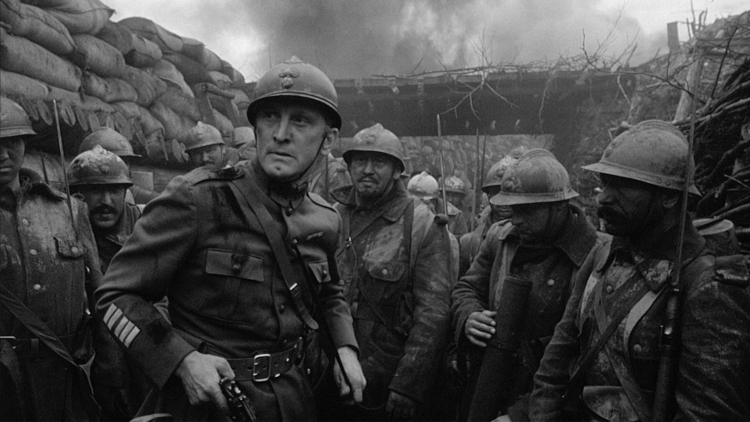
“Paths of Glory” is simply the greatest anti-war film ever made. In under ninety minutes, Kubrick drags the audience through the mud with the unfortunate French soldiers betrayed by their “superiors” in World War I. The film emphasizes just how unfair war can be, with decorated generals callously sending soldiers to their deaths for a few more medals. Part of what makes “Paths of Glory” so captivating is its structure. The film is split into two halves, the first taking place in blood-soaked trenches as Col. Dax’s men attempt and fail to take the German Anthill, and the second acting as a courtroom drama exposing the absurdity of war.

Kirk Douglas gives the best performance of his career as Col. Dax, a man with a strong moral compass doing everything he can to save the lives of three scapegoated men on trial for their lives following the attack on the German Anthill. The men are ultimately ordered to their deaths, proving this was always a no-win scenario.

Whereas most war films in the 1950’s were sprawling epics that celebrated American victory in battle, “Paths of Glory” went against the grain and instead told a somber and brutal tragedy. When the three scapegoats are faced with death, they don’t celebrate it with pride. They break down into tears as they realize their demise will be by their fellow men, not the enemy. For me, this is easily Kubrick’s most emotional film, and a true masterpiece in storytelling.

2. The Shining

Possibly Kubrick’s most iconic film, “The Shining” is an absolute masterpiece deserving of its reputation. It’s absolutely horrifying, with some of the most terrifying sequences in film history and a never-ending sense of isolation, tension, and dread. It also has a great score to emphasize the intensity and brave performances from the cast. Every time I watch it I see something new in it and want to keep exploring the mythology. There’s not much more to say, except that it’s my favorite horror film of all time.

1. Dr. Strangelove or: How I Learned to Stop Worrying and Love the Bomb

Stanley Kubrick Dr. Strangelove

There’s absolutely no competition for me. Dr. Strangelove is arguably a perfect film. Of course, it’s hilarious. Peter Sellers kills it as three totally different characters, giving each of them wildly different mannerisms while always maintaining some of the best comedic timing I’ve ever seen. Yet George C. Scott is really the standout performer as General Turgidson (this film has great names by the way). His over-the-top enthusiasm and energy never get old. He devours the screen and savors every single line. It’s easily my favorite performance of any Kubrick film.

The film is so inventive in its humor, with ironic puns such as “Gentlemen you can’t fight in here! This is the war room!,” great monologues and dialogue exchanges (particularly the phone call between the President and the incredibly sensitive Dmitri), and ridiculous situations. Major Kong riding the bomb is one of the most iconic and hysterical shots in film history. What a wild and original concept.

Additionally, this film is the perfect model of how to do messaging right. It doesn’t hold anything back, but it always has the goal of entertaining the audience — not Hollywood producers. Dr. Strangelove, while certainly profound, is incredibly exciting and warm, which is necessary for a comedy with such dark subject matter. Although the film ends in nuclear apocalypse there’s still some optimism and hope for humanity. While our main characters are largely incompetent, it’s at least comforting to know that the human race doesn’t go completely extinct. There’s a chance for humanity to learn from its mistakes, both inside of the film and in the real world.

Dr. Strangelove is a stunning achievement. It’s able to be hysterical while upholding its timeless and significant warnings for the world. I adore everything about it, from the magnificent cast of characters to Kubrick’s wicked sense of humor. For me, Dr. Strangelove is Kubrick’s magnum opus.

“The Menu” is Great Satire – Review

The Menu

“The Menu” was directed by Mark Mylod and stars Anya Taylor-Joy, Ralph Fiennes, and Nicholas Hoult. This satirical horror-thriller follows a group of elites (food critics, Wall Street types, actors, pretentious foodies, etc.) invited to the private island of renowned chef Julian Slowik (Fiennes) to experience his new, much anticipated menu. However, they’re in for a rude awakening as Chef Slowik’s menu becomes increasingly diabolical.

This film excels at poking fun at today’s self-obsessed culture and people in high societal positions. They care so much about preserving their power or perceived social awareness that they’ll be so foolish as to think that a rock on a plate or a breadless bread dish are powerful statements about the environment or humanity. They all feel pressure to share the same trendy beliefs and philosophies. Ultimately, “The Menu” shines a light on the dangers of pretentiousness and self-importance in society using its over-the-top premise and witty humor.

Speaking of which, “The Menu” is hilarious. The absurdity of the characters, particularly the two food critics who could find meaning in a damp sock, is priceless. A great running gag is when the film cuts away to a shot presenting each new menu item with the ingredients on the side. If the audience isn’t paying enough attention, they’ll miss the best jokes of the film. With just a single line, phrase, or word, the entire context of the meal will change as the viewers burst out laughing.

The humor and timeliness of the film owes a lot to director Mark Mylod’s focused vision. With his experience on HBO’s “Succession,” he understands how to portray snooty, upper-class figures in a way that’s profound without preaching to the audience. Mylod perfectly balances the absurdity, realism, and later horrors of the film. It’s an extremely impressive feature film debut, and I’m ecstatic to see his future projects.

The Menu

The performances here are also terrific. The ensemble cast of elites all have impeccable comedic timing and can balance the cartoonish natures of their characters while also being sympathetic and grounded. Nicholas Hoult in particular nails the self-importance and superficial nature of his character, playing every joke super straight as if he’s in “Airplane!.”

Hoult’s character is accompanied by his date Margot, played by Anya Taylor-Joy. Margot is a cynic and outsider to the group, immediately suspicious of Chef Slowik. Essentially, she’s the “final girl” in your typical horror movie. On the page, Margot is sort of a bland, generic character with nothing but a snarky wit, but Taylor-Joy brings the needed gravitas and charisma to make Margot likable and easy to root for.

Ralph Fiennes The Menu

Yet to no one’s surprise, Ralph Fiennes is the scene-stealer as Chef Slowik. He portrays the character with almost childlike sensibilities along with a cold, calm, and collected demeanor. He says so much without any words, particularly with his eyes. Fiennes employs several different gazes for different purposes such as intimidation, innocence, and levity. Fiennes is just so unsettling whenever he’s on screen, giving an Oscar-worthy performance that’s just as unpredictable as the script. Plus, he makes clapping the most frightening sound imaginable.

The Menu

Unfortunately, “The Menu” does have some issues. For instance, there are several scenes in the second half of the film when guests aren’t nearly as frightened as they should be. I understand this is a dark comedy, but there still needs to be weighty stakes. These “fear levels” are also inconsistent throughout the film; at one point a character will be sobbing and ten minutes later they’ll appear almost bored.

There are also some minor plot contrivances and conveniences here, especially Margot’s relationships with a few other characters and the astronomical odds of them encountering each other. Additionally, there’s an exposition dump toward the end of the film in which Slowik talks at the audience about the backstory of another character. It’s not as bad as “This is Katana. She’s got my back. I would advise not getting killed by her. Her sword traps the souls of its victims” from 2016’s “Suicide Squad,” but it’s pretty jarring nonetheless.

The Menu

Despite some plot conveniences and inconsistencies, “The Menu” is an entertaining ride that perfectly captures the insanity of modern culture with impeccable performances, sharp humor, and an unpredictable narrative.

A-

“The Banshees of Inisherin” Review – Hilarious & Heartbreaking

The Banshees of Inisherin

“The Banshees of Inisherin” was written & directed by Martin McDonagh, the director of “In Bruges” and “Three Billboards Outside Ebbing, Missouri.” Taking place on a small island off the coast of Ireland in 1923, the film follows the dimwitted and kindhearted Pádraic (Colin Farrell) when his longtime friend Colm (Brendan Gleeson) abruptly terminates their relationship. What starts as a sharp and witty comedy evolves into a heartbreaking study of loneliness, existentialism, and the need for purpose in life.

McDonagh is a master at balancing tone. He’ll have the audience belly-laughing in one scene and make them rethink their life choices in the next. Somehow every single joke in this film lands. Each one is meticulously written, performed, and edited. It’s refreshing to see a film that actually puts effort into its humor during this era dominated by generic comic book films. “The Banshees of Inisherin” doesn’t try to appease the lowest common denominator with some out of place and annoyingly safe quips. The jokes feel natural in the story, serving the narrative by calling out how over-the-top some of the situations are while also adding much-needed levity during some dark moments.

The Banshees of Inisherin

But make no mistake: “The Banshees of Inisherin” is not a film that you’ll leave with nothing but a smile. It thrives in its thematic richness with its undeniably universal messages that draw emotions from anyone who experiences it. Characters endure heavy loss, force each other to become worse people, and debate their reasons for existence on this isolated rock.

Brendan Gleeson is phenomenal as Colm, a man who simply wants to live life with meaning but becomes a monster in the process. He aims to accomplish his dreams in his fleeting years after decades of meaningless existence. He becomes terrified of death, tired of ignoring it just to learn what’s in the feces of Pádraic’s donkey. Colm is an incredibly tragic character, and while you want to like him because of how relatable he is, you can’t help but be intimidated by how far he’ll go to isolate someone as nice as Pádraic.

Colin Farrell The Banshees of Inisherin

Speaking of Pádraic, this character is one of the best of the decade, He’s undoubtedly a simpleton, living his life carefree with blissful ignorance and not realizing how immature it is to talk about donkey excrement, but that’s why he’s so lovable (and hysterical). Pádraic is just a nice guy trying to balance his relationships and stay happy. So when his life crumbles down as he slowly becomes a nastier person to cope with Colm’s actions, it’s incredibly heartbreaking.

This is Colin Farrell’s best performance. Period. In fact, I think it’s the best performance of the year thus far. Farrell is charismatic as can be here, lighting up the screen with a smile and blackening it with a simple gaze. He plays Pádraic beautifully, not overacting to express the character’s goofiness and turmoil, but rather trusting the audience to understand his thought process. It’s a wonderfully understated performance with most of the emotion being expressed through his eyes rather than his words. You don’t see Colin Farrell, just Pádraic: this endearing man who deteriorates into the kind of person he despises.

The Banshees of Inisherin

The supporting cast is outstanding as well. Kerry Condon as Pádraic’s sister Siobhan brings a great fire to her character. She’s just as funny as the rest of the cast while also having this wise intelligence and strong moral compass. In many ways she’s the antithesis of Colm; while she also yearns to escape her meaningless existence on Inisherin, she rarely endangers others to do so. Additionally, Barry Keoghan is a scene-stealer as Dominic, commonly dubbed the dumbest person on Inisherin. He’s sort of Pádraic’s sidekick despite Pádraic and everyone else despising him due to his tendency to consistently say or do the wrong thing at the wrong time. He’s basically Newman from “Seinfeld.” Who doesn’t enjoy Newman?

I also love the setting of the film. Inisherin is such a peaceful and breathtaking environment straight out of a computer lockscreen. The routines, lifestyles, and conversations of the wide array of quirky side characters are consistently entertaining as well. World-building is integral to immersing an audience, and “The Banshees of Inisherin” excels at it.

If I had to scour for negatives, I’d say the film runs on just a bit too long. There’s multiple points where you think the film is about to end, and then it’ll continue for another few minutes. Those few minutes are still great, but to get there you have to drive over a speed bump.

The Banshees of Inisherin

“The Banshees of Inisherin” has stuck with me ever since I left the theater. Using an extremely simple premise, Martin McDonagh crafted a deeply impactful and thought-provoking film full of themes and memorable characters. Unfortunately, the film has a limited release, so if you have a theater nearby that’s playing it, support the movie. It’s awesome. You’ll love it.

A

“Barry Lyndon” – Classic Film Reviews #25

Barry Lyndon

“Barry Lyndon” was written & directed by Stanley Kubrick and released in 1975. It follows Irishman Redmond Barry as he evolves from a young, naive boy into a scheming, ruthless rogue who ruthlessly climbs the social ladder of 18th century Great Britain.

Upon first glance, “Barry Lyndon” seems like it would be the most boring movie imaginable. Historical drama set in aristocratic society? Check. Three hour runtime? Check. Slow pacing? Check. However, despite all odds, legendary filmmaker Stanley Kubrick transformed “Barry Lyndon” into an enthralling and mesmerizing experience.

Easily what this film is most known for is its gorgeous cinematography. Kubrick infamously used lenses made by NASA during the film’s production to create images that look exactly like an 18th century painting. The level of precision and dedication necessary to produce such a visual style could only be done by someone as meticulous, gifted, and utterly insane as Stanley Kubrick.

Additionally, the costume design is impeccable. Normally I don’t care much about someone’s wardrobe, but with this film one can’t help but be stunned by the look of the characters. The costumes are essential for the immersion into this extravagant yet cold-hearted world, and when they’re combined with the gorgeous sets/scenery and Kubrick’s photographic expertise, true magic happens.

But the visuals and aesthetic aren’t the only sources of entertainment. The tragic arc of Barry Lyndon is absolutely compelling, not because it’s original, but because of the setting surrounding this archetype of self-destruction. The film efficiently uses all the fascinating events of its time period to present how wars and class systems could turn an innocent young man into a conniving, selfish manipulator.

“Barry Lyndon” plays out as a series of misadventures and schemes, creating a consistently entertaining narrative that’s tightly written despite the beast of a runtime. Barry goes from outlaw to soldier, from spy to confidant, from poor to wealthy, from lovesick to detached, from beloved to despised. He does whatever he can to move onto the next step in the social ladder, becoming more addicted to the pursuit of greatness. The entire narrative is built around challenging and changing the lead character — that’s the key to an excellent character study.

Barry Lyndon

“Barry Lyndon” is a terrific film, one of Kubrick’s best. It makes use of each second of its runtime to build its protagonist and immerse the audience into another century. The film exemplifies the best of cinematic escapism, which is its greatest achievement.

A+

Click here for my review of Stanley Kubrick’s “Dr. Strangelove”

“Blonde” Review – What is This Movie?

Blonde

“Blonde” was written & directed by pseudo-intellectual “filmmaker” Andrew Dominik and stars Ana de Armas as Marilyn Monroe (AKA Norma Jeane, a name said more times than the word “the” in the script). Netflix describes the film as a “fictionalized chronicle of the inner life of Marilyn Monroe.” Take the “fictionalized” part of that extremely seriously.

About a million reviews/rants for “Blonde” are surrounding the Internet currently due to it being an unbelievably inaccurate depiction of Monroe’s actual life. It’s been labeled “exploitative,” “cruel,” and “trauma porn” by many critics, and average moviegoers don’t seem to like it much either. But is it actually as abysmal as its reputation? Yeah, probably. It’s self-indulgent, unforgivably long, and criminally marketed.

“Blonde” is a tricky movie to discuss. I could write a scathing hit piece detailing how disrespectful it is (because it legitimately does spit on Marilyn Monroe’s legacy) or I could write a regular review judging the film based on its own merits and flaws. I’m going to do the latter here.

Blonde Ana de Armas

Firstly, it must be emphasized that Ana de Armas gives a mindblowing, powerful, and enthralling performance as Monroe — sorry, Norma Jeane. Obviously she looks a lot like her real-life counterpart even without any of the hair, makeup, or costumes, but that’s not what makes this performance so special. She isn’t merely imitating Marilyn Monroe — sorry, Norma Jeane — to draw in the audience. She does the hard work to make the audience feel for her, to feel like they’re a part of her, to feel like they’re enduring the pain alongside her. It took my breath away seeing how fearless and raw her performance was. She undoubtedly gave this film her all.

I also loved most of the other performances, namely Adrien Brody as Monroe’s — sorry, Norma Jeane’s — third husband Arthur Miller. It’s a very quiet, subdued performance that’s incredibly endearing, which is nice to have in such an intensely melancholy film. I will say, however, that I thought Julianne Nicholson stuck out like a wild Jared Leto. She gives such a checked out, lazy, and by-the-numbers performance as Monroe’s — sorry, Norma Jeane’s — abusive mother. The audience is supposed to be horrified of her, but since she’s so lifeless, it’s challenging to feel that instant sense of fear we’re supposed to have at the beginning of the movie. This is the most significant supporting role, bar none, as it establishes the trauma that haunts Marilyn — sorry, Norma Jeane — throughout the rest of the film. The movie needed a Frances McDormand type for this, and Nicholson just wasn’t it.

Unfortunately, besides Ana de Armas’ terrific performance, my views on all of the other aspects of the film range from mixed to furious. Starting off with the mixed, the film’s cinematography is both a blessing and a curse. “Blonde” is absolutely gorgeous thanks to director of photography Chayse Irvin. On the other hand, the way Dominik uses Irvin’s hard work is infuriating. It’s honestly like a goth teen took the Mona Lisa and spray-painted graffiti all over it.

Blonde Andrew Dominik
Visionary Filmmaker Andrew Dominik Discovering the Camera for the First Time

Dominik decided to alternate between color and black & white, as well as 4:3 and 16:9, every six minutes, causing the viewer to be drawn out of the experience by the distracting visuals. In an interview for Sight & Sound Magazine, Dominik explained that he determined the color and aspect ratio based on photographs of Marilyn — sorry, Norma Jeane –, and that “[t]here’s no logic to it, other than to try to know her life, visually.”

This doesn’t make any sense. Most scenes don’t take place at the time/location where a photo was taken, so how did he decide when to swap aspect ratios or switch between color and black & white? It can’t be based on tone because plenty of the worst moments in her life are in color and plenty are in black & white. It also can’t be based on time, because the whole movie is linear. Here’s what I believe really happened. Each day a crew member would ask Dominik, “Okay, how should we shoot this scene?,” to which the Omnipotent One would reply, “I dunno, just like, whatever man. Photos. Go find some photos of Monroe somewhere. Actually, hold on a minute. Fetch me my oat milk latte first, will you?”

Clearly, I’m not a fan of Andrew Dominik. He’s just trying way too hard. He thinks that he’s making some profound statement. That he’s revolutionizing the way movies are shot and edited. That he’s the next Kurosawa or Scorsese or Spielberg. But in actuality, he has the style of a film student flunking his classes. Dominik sprays all of his massive ego onto the screen, blocking our view of the characters and narrative. Marilyn Monroe — sorry, Norma Jeane — isn’t the focus of his movie. Andrew Dominik is. Unfortunately for him, no one cares about Andrew Dominik, and they’re certainly not going to like him after “Blonde.”

Remember, Dominik also wrote “Blonde.” So is he a better writer than director? No, absolutely not. First of all, some of the dialogue is laughably incompetent. From the out-of-place soliloquies to the unintentionally funny lines to the creepy and perverted remarks by certain characters, conversations in “Blonde” can be painful to listen to.

The structure is also abysmal. The entire point of the movie is that Norma Jeane (WOAH, I got the name right this time!) is harassed and abused by the Hollywood spotlight. This is certainly an important and meaningful message, but the film isn’t able to explore it with any real depth. The majority of the film takes place over about ten years, all of which are spent with Marilyn Monroe/Norma Jeane already being famous. Therefore, we never actually see a transformation over a substantial period of time, nor do we get to see much of the fake Marilyn Monroe persona Norma Jeane puts on for crowds. The film is so strictly in the perspective of the protagonist that the audience can feel the weight of her emotions but cannot feel the overbearing cause of them. The film plays out as scene after scene of abuse, pain, and misery, and while these moments are effective and heartbreaking at first, when pain and misery are the only elements of a film, the audience becomes numb to it after a while. “Blonde” efficiently forces us into the headspace of its lead but doesn’t give us the necessary chance to breathe so that we can feel just as much, if not more, pain all over again.

I’m devastated by how “Blonde” turned out. This was one of my most anticipated films of the year. The on-set photos and trailers looked terrific, as did Ana de Armas in the role. I was excited to see this darker, deeper take on Marilyn Monroe’s life. I rooted for “Blonde” and really, really wanted to adore it. But it’s impossible to adore a nearly three hour movie made by and exclusively for a director that’s obnoxiously pretentious.

Blonde

Ultimately, what makes “Blonde” so strangely pathetic is that its writer/director simultaneously tries too hard and not hard enough. The visuals are over-stylized and in your face, yet the dialogue and narrative are shockingly underwritten. While “Blonde” might not be the worst movie of the year, it deserves the hate being thrown at it. I just hope Ana de Armas gets an Oscar out of all this.

D-

“The Rings of Power” Review – Gorgeous Garbage

In November of 2017, Amazon paid $250 million for the television rights to “The Lord of the Rings,” and another $1 billion to produce five seasons of a prequel series. Bringing on J.J. Abrams’ Bad Robot pupils J.D. Payne and Patrick McKay as showrunners, Amazon spent nearly five years making “The Lord of the Rings: The Rings of Power” before giving the world Season 1 on September 1st (originally they were going to release it on September 2nd, the anniversary of J.R.R. Tolkien’s death). So, was it a worthy gamble for Amazon?

No. Not in the slightest.

The Rings of Power

The final product is admittedly stunning from a production standpoint, but the writing, world-building, and characters are all shameful in comparison to Tolkien’s books and Peter Jackson’s nearly perfect trilogy of films. This is a bland, generic, and soulless product that feels absolutely nothing like “The Lord of the Rings.” Whether it’s the fact that characters can seemingly teleport across Middle-Earth like they’re in “Game of Thrones” Season 8, or that the character designs look nothing like Tolkien’s creations, or that returning characters from the LOTR books/movies feel and act completely differently, this show is an insult to Tolkien, to Peter Jackson, and worst of all, to LOTR fans.

The show’s problems stem from the fact that Amazon only has the rights to the appendices from the book The Lord of the Rings: The Return of the King, meaning they only have the rights to some table scraps and have no clear story to follow, certainly not enough for a $1 billion television series. Therefore, “The Rings of Power” has to make up for it with a narrative that’s almost all filler with some new, made-up characters that are entirely uninteresting and a world that’s quite different from that of the books and movies, as this show takes place in the Second Age whereas the stories we know are from the Third Age.

Because the writers are lazy or incompetent or most likely both, they spend no time on fleshing out the world, establishing its rules, or differentiating it from the Middle-Earth we’re used to. The show jumps from place to place and from character to character with nothing but a map and some throwaway lines to explain where exactly we are, what’s happening, and how the many bloated stories will connect.

There’s no connecting tissue here, so the series just feels like a bunch of boring fantasy tales jumbled together. The only actual through-line is Galadriel’s hunt for Sauron, which is ironically the worst part of the show (we’ll get into that later, don’t fret). When we’re not following her, we’re with a young Elrond as he recruits Dwarves to build something for him (I forget and don’t care what it was). Or we’re with an Elf named Arondir, his love interest, and his love interest’s annoying son who has a legendary puberty mustache. Or we’re with a young Hobbit — sorry, Harfoot — named Lori who stumbles upon some all-powerful, mysterious wizard (who’s obviously a young Gandalf, which nobody wants to see). And these are just the first two episodes; there’s a bunch of new plot points that will be thrown at us in the next few episodes, as many of the characters that we know are supposed to be in the series haven’t showed up yet.

So, Big Issue #1 is that the audience is lost because of how jumbled and thin the stories and world are. Big Issue #2 is Galadriel. What a nightmarish character. In Peter Jackson’s movies, she was played with perfection by Cate Blanchett. An elegant, beautiful, charismatic, and inspirational figure who was the embodiment of goodness. She was even the audience’s guide to Middle-Earth in that epic prologue from the original LOTR trilogy.

Let’s contrast that with the completely different version of Galadriel in “The Rings of Power.” Here, we’re treated to a mean-spirited performance from actress Morfydd Clark. In contrast to Blanchett, Clark has absolutely no charisma, magic, or any hint of likability to her. Part of this is due to the writing, but this is also due to her acting. I get that she has some bad material to work with, but she could have at least tried to be less antagonistic. Her performance is more similar to Brie Larson’s as Captain Marvel than anything else.

The Rings of Power

Speaking of the bad material, let’s discuss it. Galadriel is the most (unintentionally) unlikable, grouchy, and aggressive presence on the series. She talks down to literally everyone she meets. She is always in a bad mood, selfish, and apathetic to the needs of others. The writers want us to think she’s some tough, cool, and mighty warrior but instead we see an utterly nasty individual. Another issue is that the writers intended to create her without flaws. She’s overpowered, stronger than everyone, always right, always the smartest person in the room. Yet, she’ll make dumb choices like jump off a boat and swim in the middle of the ocean with no real destination or sense of direction, but of course, because she’s perfect and flawless and brave and stunning, she’s strong enough to swim for what seems to be hours without breaking a sweat.

Character Writing 101 is to give a character flaws. Without flaws, the character isn’t relatable and the audience can’t connect to him/her, and therefore develops a disdain for the character. People have flaws, so when a character is heralded as perfect, he/she actually comes off as annoying and smug to the audience. Hence Rey. Hence Michael Burnham. Hence Captain Marvel. Hence Jane Foster. Hence She-Hulk. And now, hence Galadriel. It’s a shame that such a beloved and iconic character was morphed into the worst character in a show consisting entirely of bad characters.

The Rings of Power

Big Issue #3 is the dialogue. The writers couldn’t decide on whether to write lines that sound like modern-day linguistics or how pseudo-intellectuals think people in medieval times talked. “The Rings of Power” has some of the worst, most overwritten lines I’ve ever had the displeasure of hearing in any movie or television show. Here are a few bangers I found:

  • “Now we learned many words for death.”
  • “How long can living flesh endure where even sunlight fears to tread?”
  • “Sometimes we cannot know until we have touched the darkness.”

If you read Tolkien’s books or watch the Peter Jackson’s films, you won’t find a single line that’s this pretentious or Shakespearean (in the worst way possible). The writers think they’re so intelligent by writing these bangers, but really they’re just incompetent.

“The Lord of the Rings: The Rings of Power” is everything wrong with modern entertainment. It has abysmal writing and gross betrayal of beloved franchises, all disguised under some nice visuals. The special effects, production design, and cinematography are all impeccable, but who cares when there’s a story, world, and characters you can’t connect with?

All “Better Call Saul” Seasons Ranked

“Better Call Saul” just wrapped up with Season 6, so it’s time to rank all six seasons of this stellar television series from worst to best.


6. Season 2

This is the ultimate set-up season. Unfortunately, not much happens here. It follows the climactic events of Season 1 and puts the events of Season 3 in motion, but this season itself is pretty forgettable. Jimmy and Chuck’s relationship remains in the same state without any new conflicts until the last couple episodes, Mike doesn’t do much except interact with Nacho a few times, and Kim spends time highlighting documents. The characters don’t grow much and neither does the plot. Season 2 obviously isn’t terrible; the writing, particularly the dialogue, remains great, but it still has nothing to really make it stand out, unlike the other “Better Call Saul” seasons.


5. Season 1

What this season does so well is set up our characters and the arcs they’ll go on over the course of the show. Concerning our returning characters from “Breaking Bad,” Jimmy is instantly likable and distinctively different than Saul Goodman, and Mike is given a terrific backstory in his guilt over the death of his son. As for the new characters, Kim Wexler is written and played to be so charming, funny, and supportive; she’s essentially the friend we all wish we had and she’s a great counterpart to Jimmy. Chuck McGill is another terrific character, as he’s such a unique villain. He’s pretentious, smug, and dismissive of Jimmy, but he’s also undoubtedly correct in his reasoning. Jimmy with a law degree is like “giving a chimp a machine gun.” He wisely predicts who Jimmy will become in “Breaking Bad” yet we still love to hate him by the end of the season.

Whereas this season is flawless in how it introduces our characters, it’s certainly flawed in its pacing. The first two episodes move quickly and are reminiscent of the types of stories in “Breaking Bad” where a character is in a deadly situation and must find some way to survive it. But afterwards the show slows to a crawl, as the plot lines aren’t as immediately interesting. The Kettlemans are fun characters but their embezzlement isn’t so compelling, and watching Jimmy build a lawsuit against Sandpiper Crossing isn’t all that exciting either. I was never bored per-say, but this season didn’t maintain the consistent entertainment factor of the seasons higher up on this list.


4. Season 4

Where Season 4 excels is in Mike’s story of managing the German engineers as they build Gus’ meth lab. Watching this deeply cynical and tortured man actually find a friend in the lead engineer Werner Ziegler is strangely endearing. It’s a place we’ve never seen Mike in in either of the shows. But when Ziegler escapes the compound to see his wife and betrays Mike, the story turns into a tragedy that impacts the rest of the series and, more importantly, Mike’s arc. When he kills Ziegler, it’s really Mike’s origin story; his journey into becoming the cold, ruthless assassin he was in “Breaking Bad” is completed. Honestly, this might be my favorite Mike storyline in either of the shows.

Another achievement of this season was introducing us to possibly the best character of the series: Lalo Salamanca, played to perfection by Tony Dalton. Talk about a memorable villain. He’s simultaneously affable and horrifying. Lalo is just as sadistic and psychotic as the other Salamancas, but he’s the best at hiding it. On the surface he’s this lovable guy with the charismatic smile of a 1960’s movie star, while deep down he’s completely soulless.

Unfortunately, the lawyer plot lines of this season are infinitely less interesting than the cartel plot lines. We spend half of the season with Jimmy who’s temporarily banned from practicing law, picking up garbage for community service, and selling cell phones for some extra profit. After a while it gets tiresome to watch Jimmy struggle to make ends meet for ten episodes, especially because it’s something we already saw in Season 1. However, despite its flaws, I still adore this season because of how its repercussions affect the rest of the series.


3. Season 6

Better Call Saul

“Better Call Saul” Season 6 has some of the best episodes and some of the worst episodes of the entire series. Episode 603 “Rock in a Hard Place” and Episode 608 “Point and Shoot” were the most tense and exciting episodes of the show, providing immensely satisfying payoff to the characters of Nacho and Lalo. Episode 607 “Plan and Execution” was a surprising and emotional mid-season finale and Episode 609 “Fun and Games” showed the tragic end to Kim and Jimmy’s relationship. Overall, the first nine episodes that concluded the prequel timeline were enthralling and pleasantly surprising (except for some dull moments throughout Episodes 605-606). Unfortunately, the last four episodes that concluded the future timeline weren’t nearly as satisfying.

Episodes 610 and 611 felt like a strange course correction and lame epilogue to the show, letting all the air out of the balloon. In fact, Episode 611 “Breaking Bad” might be my least favorite episode of “Better Call Saul.” It’s boring, uneventful, and a complete waste of time. You could’ve cut down this episode to five minutes and it would have had the same impact on the show’s conclusion. It also has a borderline insulting throwaway cameo with Walter White and Jesse Pinkman, who don’t have any interesting dialogue, interactions, or stake in the narrative.

However, the show really picked itself back up in Episode 612 “Waterworks” and Episode 613 “Saul Gone.” It certainly helped to bring Kim Wexler into the future timeline to give the audience a break from the monotonous scam sequences with Gene and Jeff (who was poorly recast, by the way). Seeing Kim in this hopeless and futile existence was heartbreaking, especially in the scene when she breaks out sobbing, releasing all of her inner turmoil carried over the past few years. Rhea Seehorn has never been better.

While I do think the series finale “Saul Gone” is overrated since it’s entirely predictable and a bit stretched out, it was certainly the right way to conclude the series. I appreciate that showrunner Peter Gould didn’t write an obnoxious “subverting our expectations” ending (I’m looking at you, “Game of Thrones”) and instead gave us the appropriately sad yet optimistic conclusion to Jimmy McGill/Saul Goodman’s story. Jimmy finally learned to stop running from his crimes and sacrificed himself to life in prison to prove to Kim he can change into a better man. It’s not an exciting or climactic ending, but it’s suitable and fulfilling.

Ultimately, if Season 6 cut out Episode 611 entirely, shaved the runtime of other episodes down, and inserted the future timeline episodes throughout the whole season instead of dumping them all at the end, the season would move a lot quicker and feel less clunky. Season 6 certainly gave satisfying conclusions to our characters and landed the ship, but it was surprisingly poorly paced.


2. Season 3

Better Call Saul

Whereas Season 2 was an all set-up season, Season 3 was an all pay-off season, which is what makes it so thoroughly entertaining and satisfying. This is the season where Gus Fring finally enters the series, first appearing in a phenomenal sequence with Jimmy in Los Pollos Hermanos. Gus’ first words in the show are the perfect reintroduction: “Can I help you?”

We also see Nacho exact his revenge on Hector Salamanca and discover how he became the silent, wheelchair-bound nemesis from “Breaking Bad.” Then there’s the great climax Jimmy and Chuck’s conflict in what is my second favorite episode of the series, “Chicanery,” where in one epic courtroom battle Jimmy finally proves Chuck’s allergy to electricity is all in his head.

Season 3 never lets up. Episode after episode pays off all the conflicts from Seasons 1 and 2 in the most satisfying ways imaginable. It’s one of the most consistently enthralling seasons of television of the past decade and proved that this series was a worthy entry into the “Breaking Bad” universe. However, there’s one season that just barely tops it.


1. Season 5

Better Call Saul

In the “Breaking Bad” vs. “Better Call Saul” debate, I’ll always argue that BB is the superior series over BCS. After all, “Breaking Bad” is mankind’s greatest achievement. That said, Season 5 is the season of “Better Call Saul” that’s (somewhat) on par with “Breaking Bad.”

To be fair, I’m biased because Season 5 is by far the closest BCS has gotten to the style of “Breaking Bad,” as it really focuses on the drug world more than the lawyer world, which no other season does.

BCS Season 5 is relentlessly compelling, intense, action-packed, and game changing. Every episode builds the tension as Jimmy falls deeper and deeper into the madness of the cartel. His dynamic with Lalo is humorous yet terrifying; both characters are lighthearted on the surface but the audience knows how conniving and ruthless Lalo is. This leads into my all-time favorite episode of the series, 508 “Bagman,” in which Saul and Mike endure a brutal odyssey through the scorching desert to bring Lalo $7 million in bail money with no water and a bandit hunting them. At that point in the show, we’ve never seen Jimmy in this dangerous of a situation before, and it’s glorious.

This season also kicks off Kim’s arc into becoming a morally grey con artist alongside Jimmy, igniting much of the chaos in Season 6. In the final episode of this season, Jimmy asks Kim, “Am I bad for you?” Although Kim denies it, the audience knows the tragic path of both these characters and that, unfortunately, this relationship hurts everyone around them.

For me, Season 5 is the most rewatchable season. It has the fastest pacing, best dialogue, and most memorable sequences. Most importantly, it perfectly challenges every character to their breaking point. This is “Better Call Saul” at its finest.


Click here for my “El Camino” Review

“Bullet Train,” “Nope” & “Elvis” – Quick Reviews

It’s time for me to catch up on the summer’s biggest releases, so here are my reviews for “Bullet Train,” “Nope,” and “Elvis!”

Bullet Train

Bullet Train

“Bullet Train” was a massive joy from start to finish. Every actor (except for one, who I’ll discuss later) was such a fun and hilarious presence. I adored Brad Pitt as Ladybug, a tired, retrospective, and hopelessly unlucky assassin. One of the running gags in the film is that he’s always on the phone with his contractor Maria (Sandra Bullock), who he uses as a therapist to vent to during the chaos on the train. What makes his situation even funner is that he’s not even supposed to be on the train and is only there to fill in for his obnoxious coworker Carter, who’s out sick with a stomach virus.

The other standouts of the film were Lemon and Tangerine, a British assassin duo played by Brian Tyree Henry and Aaron Taylor-Johnson, respectively. Their posh accents, endless bickering, and tempers make for some quality comedic moments.

The action sequences directed by former stuntman David Leitch are exciting too, although they’re surprisingly sparse. You feel the punches between these vicious yet lighthearted assassins. These sequences are also elevated with plenty of cartoonish gore and carnage. The film is also gorgeous due to how colorful it is, as well as the scenery both inside and outside of the train. Despite the condensed setting, the movie is still able to make use of the beautiful Japanese landscape and culture. All this being said, Leitch’s style got a bit excessive at times, namely when the narrative is interrupted by a sequence involving the journey of a water bottle (possibly because of the glaring product placement for Fiji).

“Bullet Train” has an intelligent screenplay by Zak Olkewicz, although it may have a few too many twists and turns in it. You never know which character is going to die or whether he/she is trustworthy. The film always kept me on my toes, although it could have been more cohesive and focused. If you pay attention, you’ll understand everything that’s happening, but if you miss a scene or even a line of dialogue, you could be lost for a while.

Unfortunately, what often sucked the joy out of me during “Bullet Train” was the lackluster performance from Joey King, who played the young assassin named “The Prince.” Her character was meant to be an annoying, smug brat, and King sold that part, but when she needed to be intimidating, King’s performance was almost comical. I think the role required more dimensions than King was able to portray; she’s a fine actress for Netflix movies like “The Kissing Booth,” but here she felt out of her element.

B+


Nope

Unfortunately, “Nope” was a nothing-burger. I don’t understand why so many other critics have relentlessly praised this film. There are only three things that stood out: (1) Keke Palmer’s charming and charismatic performance, (2) the gorgeous cinematography by Hoyte van Hoytema and his use of IMAX cameras, and (3) the scene with the chimp, which was one of the most frightening, tense theater experiences I’ve had in quite some time (if you see the film you’ll know exactly what I’m talking about). Besides those aspects, the rest of the movie is shockingly forgettable. It’s thirty minutes too long, the main character played by Daniel Kaluuya wasn’t interesting, and the ending was underwhelming. Not much happens and the twist isn’t all that impressive. I’m surprised at how little I have to say about the film. My immediate thought walking out of the theater was, “that’s one of the most okay movies I’ve ever seen.”

C+


Elvis

I’ll get this out of the way first: I’m not a fan of Baz Luhrmann. I can’t stand his overly flashy style, odd use of modern rap music in period piece films (including “Elvis”), and ADHD editing. That said, I generally enjoyed “Elvis.” While Luhrmann’s polarizing directing style was there, he exercised a surprising amount of restraint that I greatly appreciated. I could actually understand what the heck was happening.

Anyway, as everyone knows, Austin Butler’s performance is the standout of the film. He completely transforms himself into Elvis, not just through his identical accent but also through the way he moves, both in his dancing and body language. He was incredibly endearing and charismatic as the King of Rock & Roll, especially during his dramatic moments toward the end of the film.

Unlike Butler, I disliked Tom Hanks’ performance as Col. Tom Parker. The over-the-top accent and penguin waddle were jarringly out of place when the rest of the cast are giving grounded performances. However, the character didn’t take me out of the film much because he was written far better than he was performed. The character is a diabolical, selfish villain and his manipulation of Elvis over the course of the film is heartbreaking.

What I appreciate most about “Elvis” is its soul. You could tell the cast and crew were actually fans of the artist and wanted to make a respectful biopic. This film is more reminiscent of “Walk the Line” than “Bohemian Rhapsody,” the latter being almost entirely untrue and aggressively corporate. Thankfully, Elvis” wasn’t another Hollywood cash grab.

B

“Star Trek II: The Wrath of Khan” – Classic Film Reviews #24

Star Trek

“Star Trek II: The Wrath of Khan” was directed by Nicholas Meyer and released in 1982. After the mediocre (at best) first installment in the Star Trek film franchise, Paramount needed the sequel to be a critical and financial hit. Luckily, Star Trek II turned out to be one of the best sci-fi adventure films of all time.

In case you’re unfamiliar with Star Trek II, the film follows the original crew as Spock trains a group of Starfleet cadets onboard the Enterprise and Kirk, now an aging and bored admiral, visits the ship to reminiscence about old adventures. Meanwhile, Khan Noonien Singh, a genetically engineered mastermind and villain from the original television series, returns to seek vengeance against Kirk. What ensues is a deadly game of wits between the two rivals that leads to dire consequences.

Star Trek

Nicholas Meyer’s direction is gorgeous. The effects and environments are absolutely stunning, particularly when the Enterprise and the Reliant (Khan’s starship) are battling in the Mutara Nebula. The action sequences of the film are all enhanced by James Horner’s phenomenal score that almost has a character of its own.

You can feel the passion and hard work put into this movie throughout its entire runtime. Writer Harve Bennet and director Nicholas Meyer went through several rewrites and new drafts of the script to make a tight and thematically rich film. The movie doesn’t waste a single frame. Every plot point and line of dialogue matters, and the multiple storylines interweave beautifully. If written today, Star Trek II would be an absolute mess. Modern blockbuster writers would be too lazy and incompetent to balance the stories. Star Trek II should be a lesson to today’s writers that they can make a tight story (under two hours) without sacrificing coherence.

Star Trek II was the darkest the franchise had ever gotten at the time (both in television and film). There’s genuine violence and stakes. Characters have to face the consequences of their actions. Everyone is pushed like they’ve never been pushed before, which is what makes the film so enthralling.

Another terrific aspect of this film is its thematic richness. The movie isn’t just an epic space battle; it’s about universal themes like aging, regret, and feeling unfulfilled in life. Kirk is in an unhealthy state of aging; he’s stuck in what’s essentially a boring desk job when he should be out exploring the galaxy. He needs excitement in his life and his arc is to learn to “feel young” again.

Star Trek

Star Trek II has stellar performances across the board. Of course, Ricardo Montalbán is incredibly charismatic and electrifying as Khan, giving cinema one of its most iconic villains. But because of how flashy Montalbán is, people overlook the work of the other actors. Leonard Nimoy has never been better as Spock. At this point, he was quite experienced in the role and had the enduring chemistry with the rest of the cast, making for a Spock that’s more understanding of human emotions.

However, William Shatner as Kirk actually gives my favorite performance of the film. Star Trek II is very much Kirk’s story. The script demands Shatner to be the lighthearted adventurer he was in the original series, but also requires him to portray raw emotions. It’s easy to make fun of Shatner for his rapid-pause-rapid line delivery and corny Kirk-fu, but his acting chops shouldn’t be overlooked, especially in this film.

Star Trek

Currently we’re seeing a repugnant trend in Hollywood where they bring back the (literally) old cast of a long-running franchise for a new, far worse film, only to see them be heartlessly killed off. I’m looking at you, Disney Star Wars. I don’t have any issue with killing off legacy characters; it’s just the way that they’re killed off that’s important. In Star Trek II, Spock’s death is brilliant. He sacrifices himself to save his friends, gets some final meaningful words in, and the last thing he sees is his friends saying goodbye. The film then ends with Spock delivering the iconic opening “Where No Man Has Gone Before” monologue from the original series, ending the film on a sad yet optimistic note. That’s how you kill off an iconic legacy character. You give them the respect they deserve and one last interaction with the people they’re closest to, as well as callbacks to past events in the franchise. Contrast Spock’s death with Luke Skywalker’s despicable demise in “Star Wars: The Last Jedi,” where he just fades into thin air lightyears away from the other characters. He never gets to interact with Han and only talks to Leia through Force Skype. He starts and ends the film as a cynical recluse, dying alone without doing anything particularly memorable in the movie. That’s not only poor writing, but it’s just an insult to the character’s legacy and the audience. Star Trek II celebrates Spock whereas The Last Jedi slanders Luke.

“Star Trek II: The Wrath of Khan” is one of the best sequels ever made. It takes everything great from the original series and expands upon it to deliver an impactful and endlessly rewatchable adventure that celebrates the franchise.

A+

“The Northman” is Awesome – Review

The Northman

“The Northman” was co-written and directed by Robert Eggers and stars Alexander Skarsgård as Prince Amleth, a brutal viking on a quest to fulfill his vow to avenge his murdered father. The film also stars Nicole Kidman, Anya Taylor-Joy, Claes Bang, Ethan Hawke, and Willem Dafoe.

If you’ve seen Robert Eggers’ previous work (“The Witch” and “The Lighthouse”) you’ll know what to expect: trippy visuals and metaphorical imagery — basically, an art film that’s not for everybody. But if you like Eggers’ style like I do, you’ll absolutely love this movie. The trailers were intentionally misleading, making the movie seem like an action-packed epic using almost exclusively clips from the first act. One of the most interesting aspects of this film is its structure: as mentioned, the first act is more of a conventional straight-up action movie while the second and third acts focus on slower-paced psychological drama. It almost feels like Eggers did this to make the film more marketable for the general audience, but I’m fine with it, as it makes for an unexpected and more enjoyable experience.

The Northman

While this is no action movie, the action that is in it is some of the best of 2022. Every single action sequence is shot with minimal cuts, most of them being single take battles and sword fights. There’s a particular raid sequence in the beginning that’s so brutal and so impressive that it’s worth the price of admission (or VOD rental/purchase) alone.

Throughout its entire runtime “The Northman” is gorgeous. Firstly, it’s almost entirely shot using natural lighting; given it’s a viking movie that takes place in the tenth century, the characters spend most of their time outdoors. The lighting makes you feel more invested in this immersive world, also aided by the stunning landscapes and colors. The use of oranges, blues, and blacks are exaggerated to make for a more trippy experience that fits the tone. Truly brilliant direction, cinematography, and production design.

Eggers has stated in many interviews that he and his team tried to make the most “accurate viking movie” ever made, and I think they succeeded. Beyond just the period-accurate sets and costumes, the world of “The Northman” doesn’t pull any punches when it comes to showing what viking culture was really like back then. Vikings weren’t a bunch of guys with horns on their helmets. They were vicious, immoral, and repugnant warriors who valued feats of dominance more than almost anything. These were murderers who had no issues burning villages and killing innocent people, and seeing Amleth start his path among these people makes for a more tragic character.

The Northman

Speaking of Amleth, he’s one of my favorite movie protagonists of the past few years. He has some of Skarsgård’s natural charisma and you really sympathize with his tragic past, as well as his legitimately heartfelt romance with a slave named Olga (Anya Taylor-Joy). But along with his likable qualities are some truly despicable ones, such as his malicious viking tendencies and his singular focus on vengeance. The film tests him throughout the narrative, particularly in the latter half of the film, when he has to question how long he’ll keep up this violence after falling in love with Olga and (no spoilers) committing some unforgivably evil acts. His journey and arc are the strong emotional center of the story. That said, since Amleth’s arc is so brutal, the film doesn’t have much rewatchability to it.

I feel the need to reiterate that this is an art film. It’s essentially a big-budget A24 film made by a different studio. If you liked last year’s “The Green Knight” like I did, then this is right up your alley.

Robert Eggers’ “The Northman” is both a period epic and a psychological thriller which is immensely satisfying throughout. This is one of my favorite movies of 2022 so far and I strongly recommend it.

A